The number nobody will name
The Government says there is no plan for ten million. Granted. But that was never the real question. Singapore grants around 22,000 citizenships and 35,000 PRs a year, the population has climbed from 5.31 million to 6.11 million, and the one resident ceiling ever named has quietly been reached. So when does the increase stop? Thirteen years on, nobody will name the number.

Let us begin by granting the Government its point, because the point is correct.
There is no plan for a Singapore of ten million people. The figure was never in the 2013 Population White Paper. It was raised by opposition parties during the 2020 General Election, and the Government has said, in terms, that it has "not proposed, planned nor targeted" any such number.
When the Singapore Press Club asked Prime Minister Lawrence Wong on 8 June whether a new White Paper might set a planning parameter "at 10 million", his reply was, by his own expression, incredulous: "How do we get to 10 million when the TFR is so low?"
On the narrow question, he is right. The Total Fertility Rate reached 0.87 in 2025, a fresh record low, and no one expects it to climb back. Singaporean births alone will not carry the population to ten million. They will not carry it to 6.9 million. On the arithmetic of the cradle, the case is closed, and we do not dispute it.
We accept, then, that there is no ten-million plan. We note it plainly so that there is no confusion about what follows. Because accepting it does not answer the question that matters. It sharpens it.
The question is this: when does the population increase stop?
Not whether it stops at ten million — we have already accepted there is no such target. The question is more basic and has never been answered. Singapore grants citizenship to roughly 22,000 people a year and permanent residence to roughly 35,000, figures Gan Kim Yong characterised in his February Budget update as around 25,000 and around 35,000 in 2025.
On top of that sits a non-resident population that has driven almost all of the country's recent growth.
As at June 2025, the total population stood at 6.11 million: 3.66 million citizens, 0.54 million permanent residents, and 1.91 million non-residents — nearly a third of everyone on this island.
Over the decade to 2025, the total grew at one per cent a year. Citizens grew at 0.82 per cent. The non-resident population grew at 1.57 per cent. It is non-resident growth, not citizen growth, that moves the headline number.
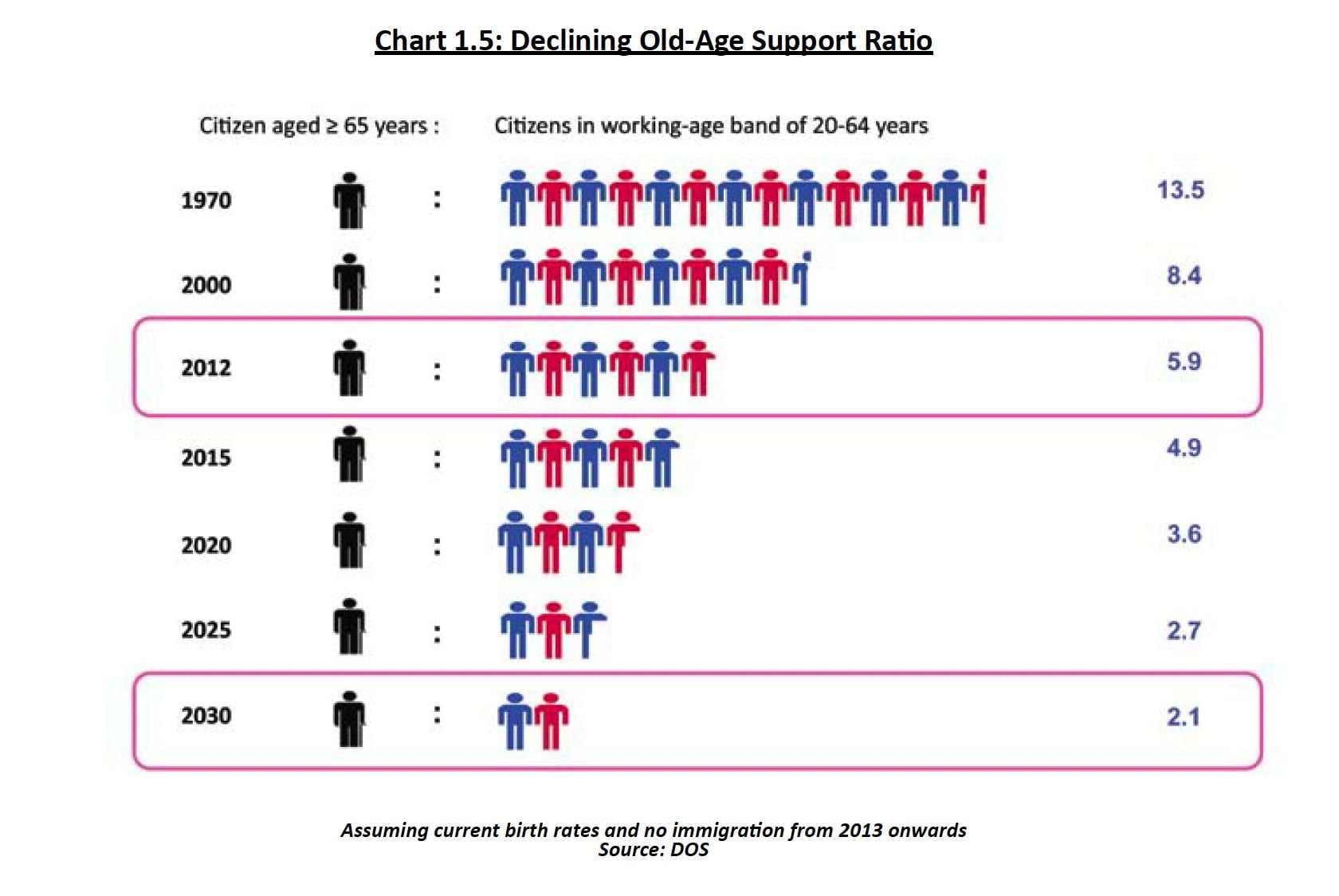
An intake of that size cannot be switched off in a single year. Nobody is suggesting it should be. To halt the inflow of new citizens and residents overnight would produce precisely the demographic collapse the White Paper was written to prevent — the hollowing of younger cohorts, the crash in the old-age support ratio that the 2013 paper projected would fall from 5.9 working-age citizens per senior to 2.1 by 2030.
The Government understands this better than anyone. It is the founding premise of its own population policy.
Which means that if the population is ever to stabilise, the annual intake must be tapered — reduced gradually, over years, towards some lower steady rate that holds the total at some chosen level. A taper has three features: a point at which it begins, a slope at which it descends, and a number at which it settles.
In thirteen years, the Government has named none of them.
The White Paper projected to 2030 and stopped. It offered a 2030 range of 6.5 to 6.9 million and said nothing about 2040, or 2050, or where the line eventually flattens.
The closest anyone came to addressing the endpoint was former Prime Minister Lee Hsien Loong, in his closing speech to Parliament in February 2013.
He said the resident population — citizens and permanent residents — would "stabilise, at most, at 4.2 million to 4.4 million eventually", and that "after that, it is flat."
He acknowledged that the non-resident population "will also eventually have to level off", because otherwise "we will have more and more non-residents per Singaporean and I do not think that is acceptable."
But he attached no number to that levelling-off and no date. Asked, in effect, where it all ends, he said: "When and where? Time will tell."
That was the answer in 2013. It remains the answer today — and in the intervening years one part of it has quietly expired. Lee described 4.2 to 4.4 million residents as the "eventual" steady state, the boundary beyond which the resident population would not grow.
As at June 2025, the resident population — 3.66 million citizens and 0.54 million permanent residents — stood at 4.2 million.
The "eventual" ceiling has been reached. It arrived in 2025, not at some distant horizon, and it arrived at the bottom of a band the Government has never since revised, in either direction.
This is the part that should trouble even those untroubled by the rest. A figure presented in 2013 as the long-term limit of the resident population has effectively been met. Yet no replacement benchmark has been articulated.
If 4.2 to 4.4 million was the steady state, are we now at it — is the resident population to hold here? Or has the ceiling silently moved, and if so, to what? The Government has not said. The one boundary it named has been reached, and the question of what now stands in its place has gone unanswered.
And the non-resident figure Lee declined to bound at all is the very figure carrying the growth. The one number he named has already been reached; the one number he never named is the one that matters.
Every official statement since has restated the 2030 ceiling and gone quiet on everything past it. A Factually article in 2020. Indranee Rajah's written parliamentary reply of 16 October 2024, confirming the total would remain "significantly below 6.9 million by 2030."
The Population in Brief reports, year after year. And now Wong, who, asked directly whether there would be an updated White Paper with a new planning figure, replied that there is "no new figure to be updated", that Singapore is "still far away" from 6.9 million, and that the country is "just trying to maintain stability and to avoid population decline."
There was meant to be a mechanism for exactly this. The motion Parliament ultimately passed in 2013 was not the Government's original motion. Members amended it, striking out the words "population policy" and adding a requirement that the Government "carry out medium term reviews of our population policies and assumptions" in light of changing circumstances.
The amendment was not incidental. It reflected Parliament's recognition that population assumptions would need to be revisited as circumstances changed.
Yet thirteen years later, no standalone medium-term review of the White Paper's assumptions has been published. There have been annual population reports, Budget statements, parliamentary replies and repeated assurances that the 6.9 million figure remains a planning parameter rather than a target.
But the review Parliament called for was not merely a running commentary on yearly numbers. It was supposed to revisit the assumptions themselves. The resident population benchmark Lee Hsien Loong described as an eventual steady state has already been reached.
Fertility has fallen well below the levels assumed in 2013 — the White Paper worked from a Total Fertility Rate of 1.20; it is now 0.87. The demographic circumstances are plainly different.
If the promised review has occurred, Singaporeans can reasonably ask where the reassessment is, what conclusions it reached, and which assumptions remain unchanged.
Instead, the concept of review appears to have shifted meaning. What was originally presented as a future exercise of reassessment is now treated as a continuous process of monitoring. Perhaps that is sufficient from the Government's perspective. But it leaves unanswered the very question Parliament inserted the review mechanism to address: when circumstances change, what part of the original roadmap changes with them?
Maintain stability. The phrase does a great deal of work. Stability of what? Not of the figure — the figure has risen every year the borders were open. The population was 5.31 million when the White Paper was written. It is 6.11 million now.
It is, on the Government's own account, heading higher, "at a much slower rate than before", but higher. Stability, here, does not mean the number holds. It means the rate of increase is managed. Those are different things, and the difference is the whole of the matter.
This is why "6.9 million is not a target" reassures less than it is meant to. A ceiling for 2030 postpones the question of what comes after 2030; it does not answer it. The 6.9 million figure is described as a parameter the country will stay below — but "below" requires the inflow to slow, and the slowing has never been specified, scheduled, or quantified.
Apply the White Paper's own method — take the observed trend and project it forward — and even granting, as one must, that current rates need not be future rates, that immigration fluctuates, that a downturn or another pandemic could break the assumptions overnight, the figure the Government insists is not a target is reached, on nothing more than the continuation of what is already happening, somewhere around the late 2030s.
The point is not the precision of the year. The point is the direction, and that the direction has no stated stopping place.
We are not predicting that. Projections are not promises, as the Government rightly insists about its own. We are pointing at a silence.
The Government has told Singaporeans what the population will be in 2030 on at least four separate occasions. It has never told them what it will be in 2040. It has never named the year the intake begins to taper. It has never named the total at which the country is meant to settle. It has named every milestone except the destination.
It may be objected that no such destination can be named — that future labour demand, technology, life expectancy and fertility are unknowable decades out, and that asking for a 2050 population figure is to demand a false precision no responsible government could offer. There is force in that.
But it does not dissolve the question; it merely reveals which answer is being withheld. There are only three honest possibilities.
Either the intention is to taper the intake towards a stable population, in which case Singaporeans are entitled to know roughly when the tapering begins and where it leads.
Or the intention is to sustain an intake of twenty to thirty thousand new citizens and a comparable flow of residents indefinitely, in which case that should be said plainly, because sustaining an open-ended intake of that scale is a profound thing to choose, and choices of that magnitude are stated, not left to inference.
Or there is no endpoint by design — demographic management is simply permanent, the number whatever the economy each year requires. That, too, is an answer. It happens to be one the Government has never stated, leaving Singaporeans to infer it.
If demographic growth has no destination, the public is owed that sentence, in plain terms, rather than left to assemble it from thirteen years of figures that only ever reach to 2030.
So we grant the denial. There is no ten-million plan. There is, equally, no publicly stated equilibrium population, no published tapering pathway, no declared endpoint for the growth model that has governed Singapore's demographics for more than a decade — and no sign of the medium-term review Parliament called for to reassess exactly these assumptions, only the claim that the reviewing never stops.
The argument here is not that the destination is secretly ten million. It is that there is no stated destination at all, and that the one instrument Parliament created to reassess the assumptions has, after thirteen years, produced no publicly identifiable reassessment of them — and that the absence of an answer, after all this time, is itself the thing that warrants an answer.
When does it stop? Thirteen years on, the most precise answer the Government has offered remains the one Lee Hsien Loong gave in 2013.
Time will tell.