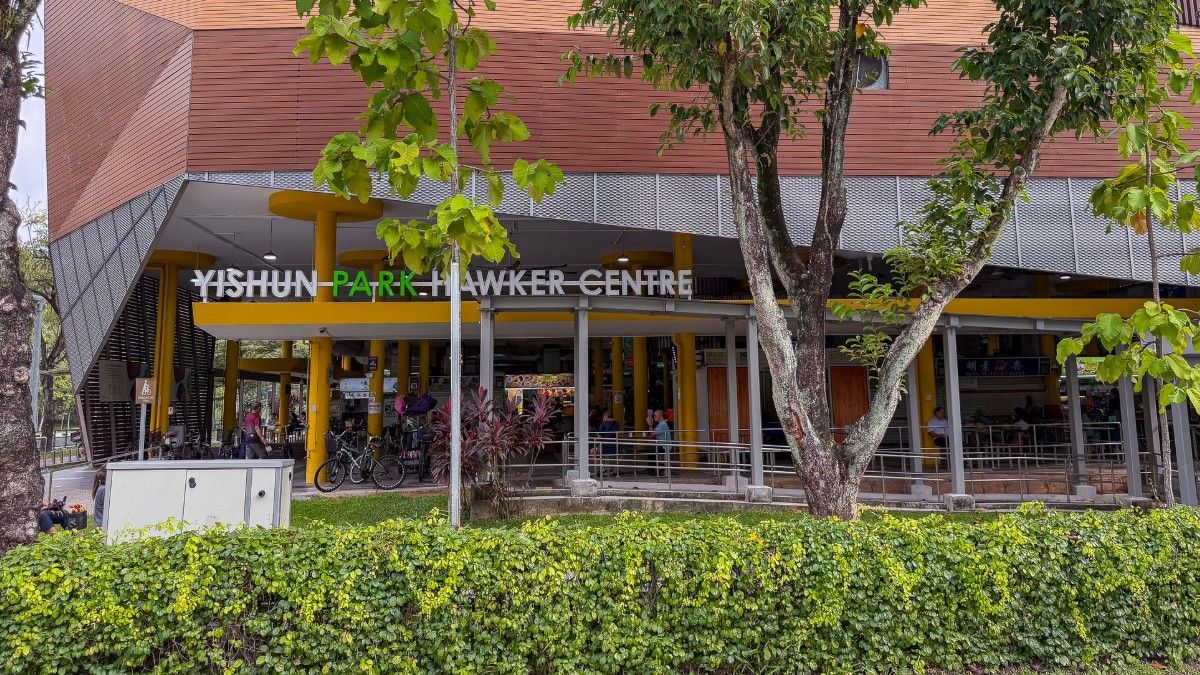
KF Seetoh urges hawkers to raise prices amid rising costs and economic uncertainty
KF Seetoh calls on Singapore’s hawkers to raise prices to survive rising costs, warning of mounting financial pressures across the sector. Netizens largely support the move, while debates emerge over affordability, government roles, and long-term sustainability.

- KF Seetoh urges hawkers to increase prices due to rising costs
- Netizens largely support but debate affordability and policy issues
- Structural challenges like labour, rent, and wages remain key concerns

Singapore’s veteran food critic KF Seetoh has again raised concerns over mounting financial pressures faced by hawkers, urging them to increase prices to remain viable amid rising costs and global uncertainty.
In a Facebook post on 18 March 2026, the founder of Makansutra highlighted the growing strain on hawkers, describing current conditions as “chaotic, expensive and dangerous”.
Seetoh pointed to broader economic trends, noting that industries such as airlines and ride-hailing services have already raised prices to offset fuel and operational costs.
He argued that similar pressures are cascading through the food supply chain, affecting transport, ingredient sourcing, and daily operations for hawkers.
“When energy and petrol prices rise like a rocket, it’s a domino effect,” he wrote, adding that suppliers inevitably pass increased costs on to food vendors.
Seetoh also questioned whether consumers fully understand the scale of cost increases, particularly for essentials such as cooking oil and bottled gas, which have surged significantly over the past three years.
Call for price adjustments
Urging hawkers to act, Seetoh encouraged them to raise prices, at least temporarily, to reflect current realities.
He stressed that such adjustments should remain reasonable and transparent, and that hawkers need not justify their decisions excessively.
According to his post, prices could be revised downward again if costs stabilise, while government support measures such as CDC vouchers could help cushion the impact on consumers.
Seetoh also acknowledged the generosity of many hawkers, noting that some continue to provide meals at cost or for free to those in need, despite lacking formal subsidies.
Public reaction reflects broad support
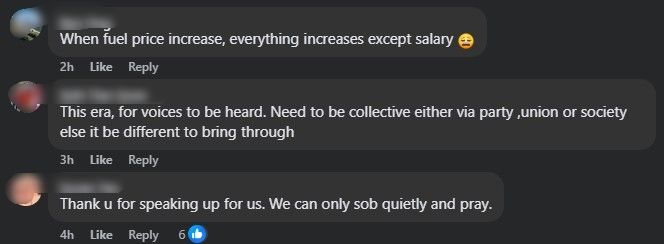
Online responses to Seetoh’s comments were largely supportive, with many netizens agreeing that price increases are justified given rising expenses.
Several highlighted key cost drivers, including rent, fuel, ingredients, and wages, arguing that hawkers have little choice but to pass these on to customers.
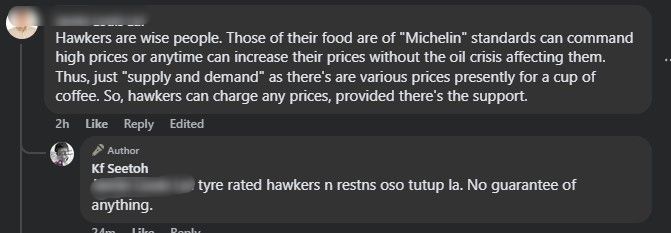
Some comments suggested that hawkers offering premium or “Michelin-standard” food could command higher prices based on demand, leaving pricing decisions to market forces.
However, Seetoh countered that even highly rated establishments are not immune to financial pressures, noting that reputation does not guarantee sustainability.
Concerns over policy and affordability
The discussion also revealed frustration among some netizens regarding broader economic and policy issues.
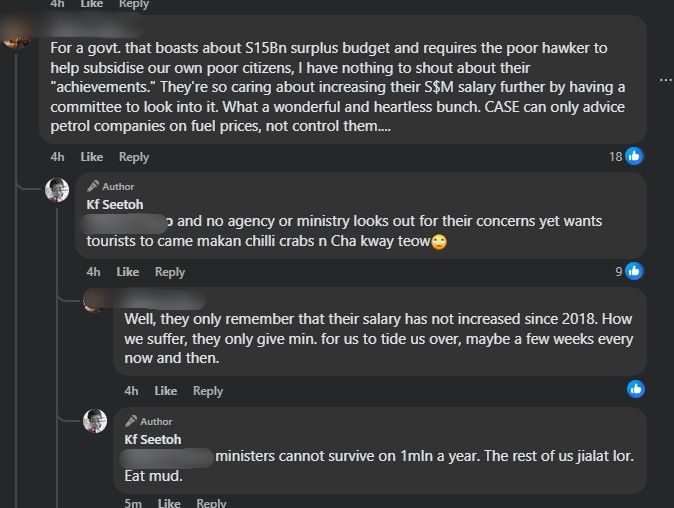
One comment criticised the government for maintaining a budget surplus while expecting hawkers to shoulder social responsibilities, arguing that policymakers are disconnected from ground realities.
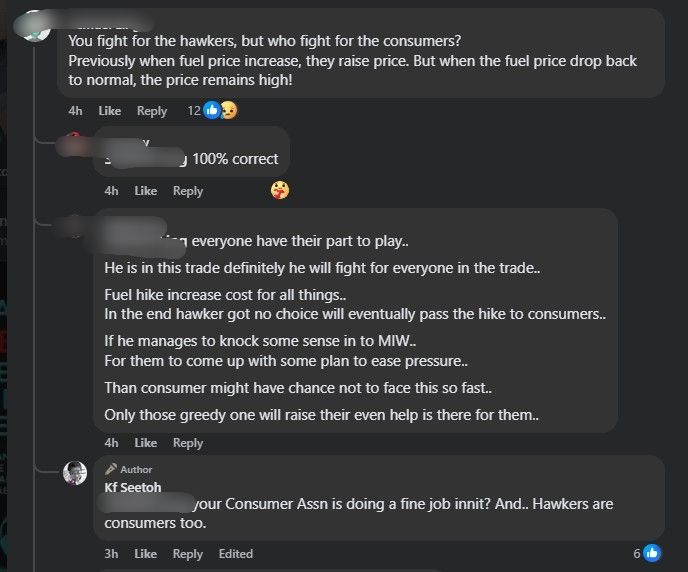
Others expressed concern that consumers are being overlooked, noting that prices rarely decrease even when costs fall.
At the same time, several defended hawkers, suggesting that only a minority overcharge, while most are simply responding to unavoidable increases.
Structural challenges beyond pricing
Beyond immediate cost pressures, contributors highlighted deeper structural issues affecting the hawker sector.
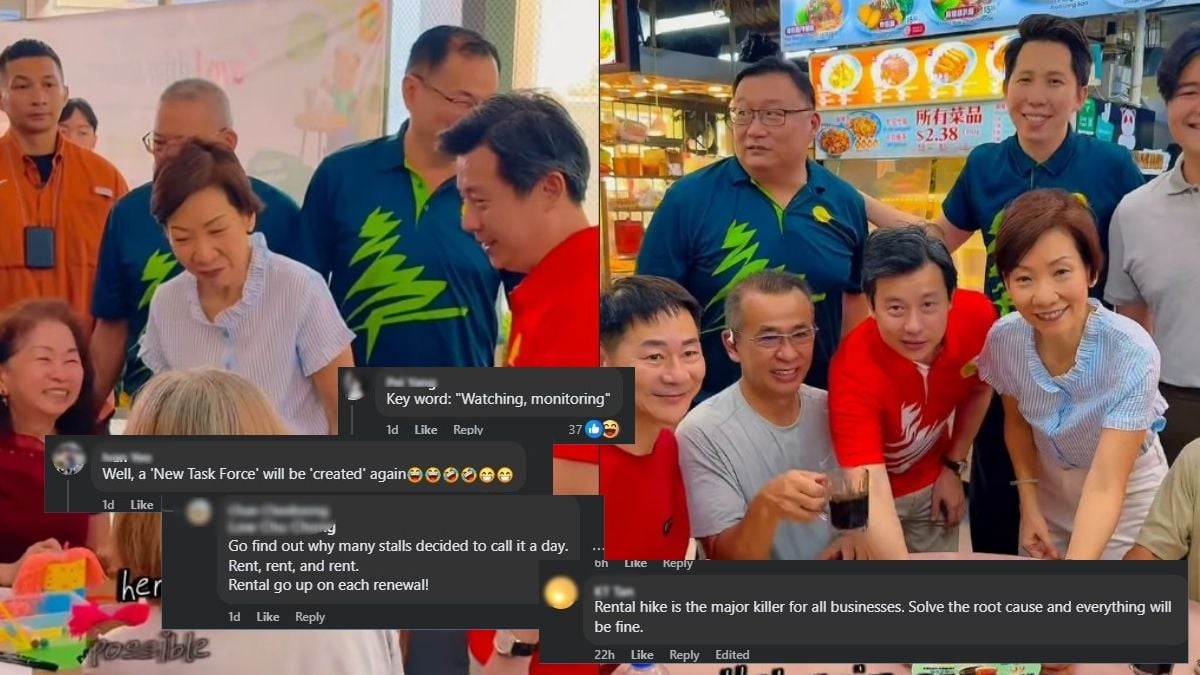
These include limited access to foreign labour, rising minimum wages, and difficulties in business succession.
Some argued that closures are not solely driven by rent, but also by poor planning or a lack of long-term sustainability strategies.
Seetoh added that hawkers themselves are also consumers facing rising living costs, calling for a more balanced understanding of the situation.
Suggestions for addressing these challenges ranged from collective action and unionisation to more structured price adjustment mechanisms.
However, scepticism remains over the feasibility of such measures, with some arguing that market dynamics and consumer choice will ultimately shape outcomes.
Others noted that increasing operational costs, including utilities and supply chains, make price hikes inevitable, while consumers may respond by seeking alternatives such as home cooking.