Calls grow for action on hawker costs as Grace Fu says food price pressures are being monitored
Calls for structural reforms and immediate intervention grew online after Sustainability and Environment Minister Grace Fu said Singapore is monitoring food price pressures amid rising logistics costs. Many netizens argued rental costs remain the key driver of higher hawker food prices.
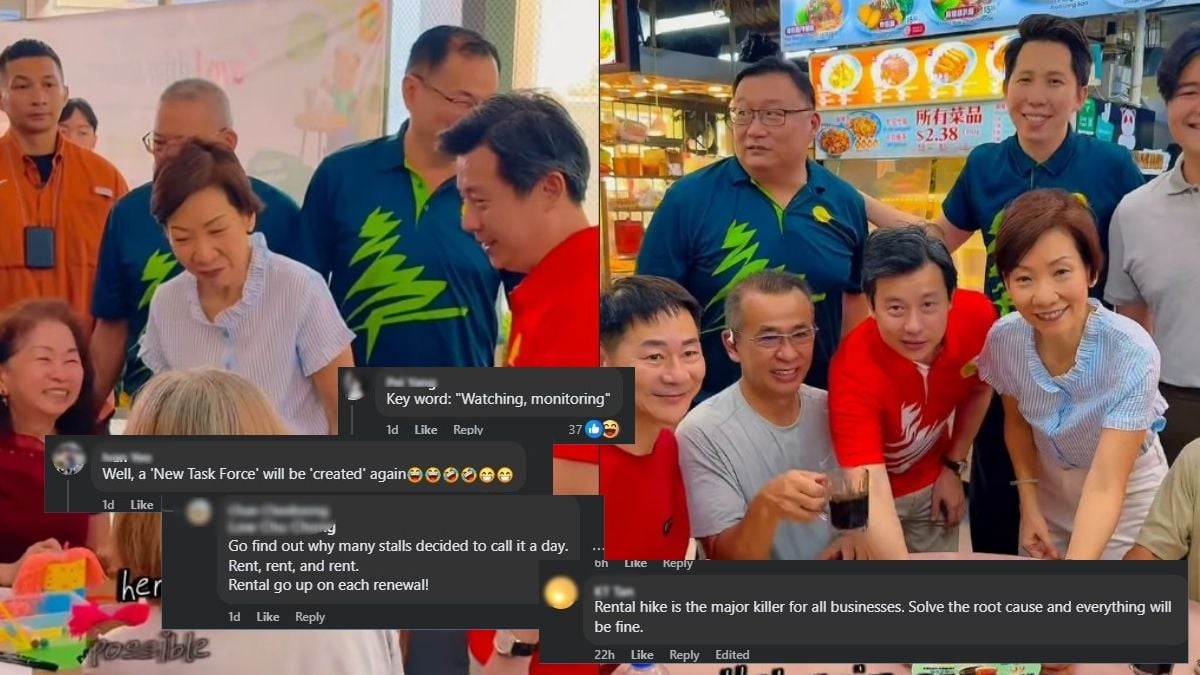
- Grace Fu said Singapore is monitoring food price pressures and stands ready to assist hawkers if necessary.
- Many netizens argued rental costs, not food prices, are the main cause of rising hawker food prices.
- Online commenters called for immediate reforms, including rent controls and measures to preserve affordable hawker food.

SINGAPORE: Calls for stronger intervention to address rising food costs emerged online after Minister for Sustainability and the Environment Grace Fu said the Government is closely monitoring the impact of cost pressures on food prices, particularly those affecting hawkers.
Speaking during a ministerial community visit to the Canberra ward of Sembawang GRC on 6 June 2026, Fu said supporting hawkers' livelihoods remains an important priority as authorities assess the impact of rising costs on the sector.
According to The Straits Times, Fu said the Ministry of Sustainability and the Environment and the National Environment Agency (NEA) have been engaging hawkers and food distributors to better understand the challenges facing the industry.
While wholesale food prices have remained relatively stable, she noted that increasing logistics costs continue to place pressure on food prices.
“We understand that the cost of food is a big part of their expenses, and we are to stand ready to assist them if needed,” Fu said.
Global energy uncertainty raises concerns
Fu's comments come amid continued volatility in global energy markets following the outbreak of war involving Iran, the United States and Israel in February.
The conflict has contributed to uncertainty surrounding oil and gas prices, raising concerns about transportation and logistics costs across international supply chains.
Singapore authorities have been monitoring developments closely as broader cost-of-living pressures remain a key concern for households and businesses.
Beyond direct government measures, Fu also highlighted the role of community-led initiatives in helping residents manage rising expenses.
She said grassroots organisations and community groups could complement government efforts by providing support to households facing cost pressures.
Online reactions focus on action over monitoring
However, many online comments responding to reports of Fu's remarks argued that monitoring alone was insufficient.
Comments appearing on platforms including Mothership, The Straits Times, Yahoo's Facebook page and Reddit reflected frustration over what some described as a recurring pattern of official assurances that authorities were "monitoring" developments.
Several commenters questioned whether assistance should already be forthcoming given the financial pressures faced by businesses and consumers.
One comment mocked the approach, writing: “Monitoring …. Then set up task force next ah? Then monitoring again ….”
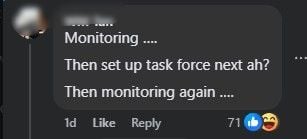
Another commenter similarly ridiculed what they viewed as a bureaucratic response cycle, stating: “Watch... then setup whatever force to monitor... then evaluate... then consider... then whatever is next.”
Others focused on the repeated use of terms such as “watching” and “monitoring”, suggesting that the public was looking for clearer policy measures rather than further observation of market developments.


A separate comment criticised what it viewed as a lack of practical solutions.
“They are aware of the rising costs, so they will monitor and assist by urging people to be prudent when it comes to buying food. Any other methods?” the commenter wrote.

Questions raised over timing of assistance
Several commenters challenged Fu's statement that authorities stood ready to assist “if needed”.
“What do you mean by ‘if needed’? Obviously the need is there!” one online user wrote.

Others argued support should have been introduced earlier, particularly given the pressures faced by small businesses since the COVID-19 pandemic.
One comment questioned how severe conditions would need to become before assistance was provided, citing reports of businesses struggling with rising operating expenses and closures.
The same comment called for stronger intervention to address rising costs, including measures to regulate hawker rent increases.
The commenter warned that food prices could continue climbing if operating costs remain unchecked and stressed that hawkers themselves face increasing pressure while attempting to maintain affordable prices.

Rental costs emerge as dominant concern
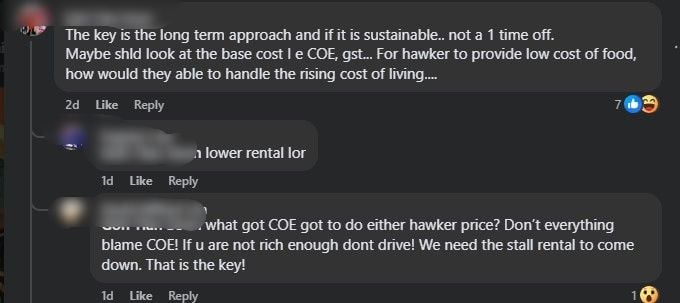
A recurring theme throughout the online discussion was the belief that rental costs, rather than food ingredient prices, are the primary factor driving higher food prices.
Many commenters argued that rental issues were not being addressed directly and called for measures to reduce rents, regulate landlords and tackle excessive subletting practices.


One online comment described rental costs as the key challenge confronting hawkers and urged policymakers to focus on structural issues affecting the sector.
The commenter argued that reducing rents and lowering operating costs would provide more meaningful relief than continued monitoring of food price pressures.
Others questioned whether existing support initiatives would have any significant impact on the prices ultimately paid by consumers.

Broader concerns over cost pressures
Beyond rental costs, some commenters pointed to other expenses they believe contribute to rising food prices.
These included utilities, operating costs and the Goods and Services Tax (GST).
Several questioned whether government support programmes would translate into tangible savings for consumers.
Some comments also referenced past public discussions encouraging consumers to switch to lower-cost food alternatives.
References to suggestions such as consuming eggs or fish instead of chicken were frequently made in a sarcastic manner, reflecting concerns that households were being asked to adapt their spending habits while underlying cost pressures remained unresolved.

Calls for structural reforms
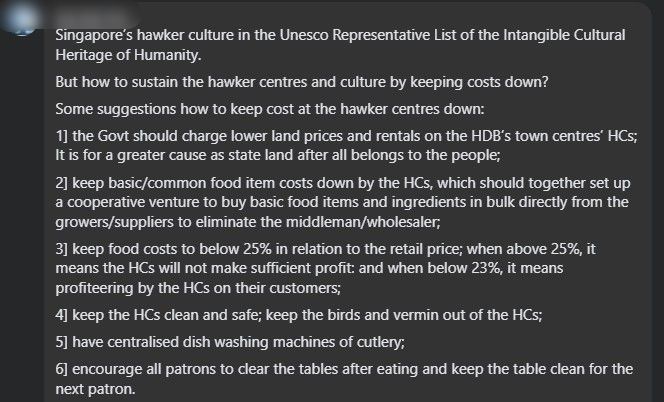
A smaller group of comments proposed specific policy measures aimed at preserving the affordability of hawker food over the long term.
Suggestions included tighter regulation of hawker centre rents, restrictions on excessive subletting, bulk purchasing arrangements for ingredients and broader reforms designed to keep operating costs manageable.
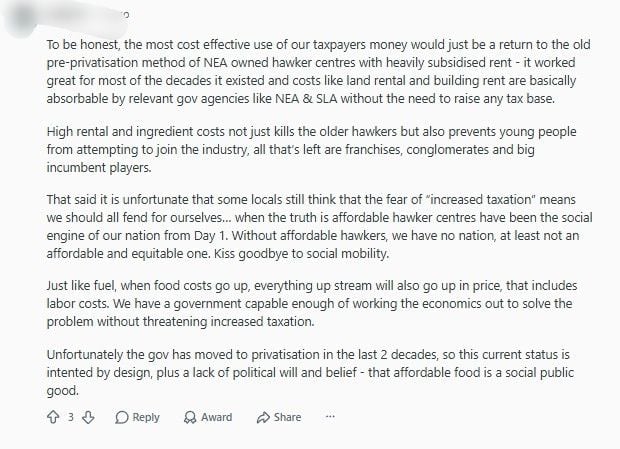
On Reddit, one commenter argued that a return to the pre-privatisation model of NEA-operated hawker centres with heavily subsidised rents would be the most effective solution.
The commenter said the previous model had helped maintain affordable food prices for decades without requiring additional taxation.
Others argued that rising rents and operating costs were contributing to the departure of older hawkers while discouraging younger individuals from entering the trade.
Some expressed concern that larger operators were becoming increasingly dominant within the sector.
Several commenters characterised affordable hawker food as an important public good and a central part of Singapore's social fabric.
They urged policymakers to treat hawker centres as an essential service and to implement long-term measures aimed at preserving affordability for both hawkers and consumers.
Hawker concerns remain in focus
Fu’s remarks come amid continuing concerns over the sustainability of Singapore’s hawker trade.
Many hawkers have cited rising operating expenses, manpower shortages and rental costs as key challenges affecting the viability of their businesses.
The issue has attracted growing public attention as policymakers and industry stakeholders seek ways to preserve Singapore’s hawker culture while ensuring businesses remain financially sustainable.
In May, Prime Minister Lawrence Wong highlighted the importance of preserving the nation’s hawker culture during a visit to veteran hawker Roger Wong Hien Lai at Marsiling Lane Food Centre.
During the visit, Wong acknowledged the long hours and commitment required of hawkers and encouraged Singaporeans to continue supporting local food businesses to ensure the culture endures for future generations.
Calls for longer-term solutions
Despite public recognition of hawkers' contributions, some industry observers have argued that more structural reforms are needed.
Hawker advocate KF Seetoh welcomed efforts to highlight the role of hawkers in Singapore society but said policy measures should go beyond symbolic support.
He argued that issues such as rental frameworks, operating costs and management practices require closer attention to strengthen the long-term sustainability of the sector.
Seetoh described Singapore’s hawker culture as a national heritage facing increasing pressures and said addressing structural challenges would be important to securing its future.