Singapore MRT reliability hits strongest level in nearly 18 months after Downtown Line surge
Singapore’s MRT network recorded its best reliability performance in nearly 1.5 years in April 2026, driven by a sharp improvement on the Downtown Line, according to the Land Transport Authority’s latest monthly rail reliability report released on 15 May 2026.

- Singapore’s MRT reliability rose to its highest level since November 2024 in April 2026.
- The Downtown Line’s reliability doubled, significantly boosting overall network performance.
- No MRT disruptions exceeding 30 minutes were recorded during the month.

Singapore’s MRT network recorded its strongest reliability performance in nearly 18 months in April 2026, following significant improvements on several major rail lines, according to the Land Transport Authority’s (LTA) latest monthly report released on 15 May 2026.
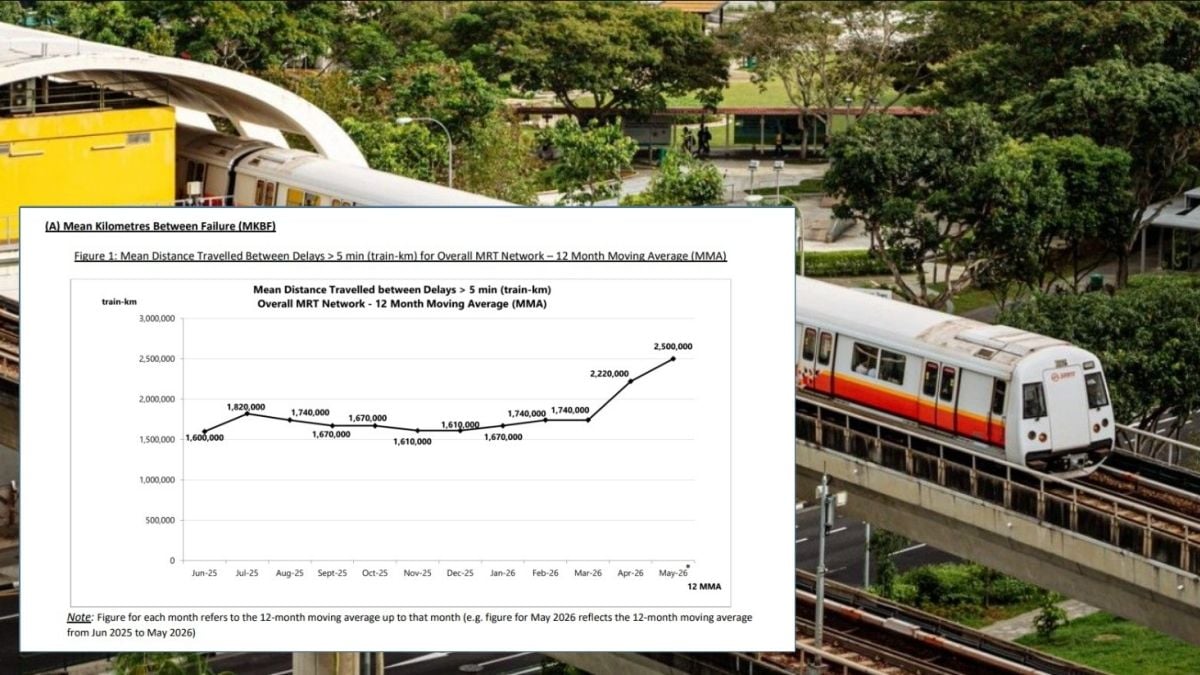
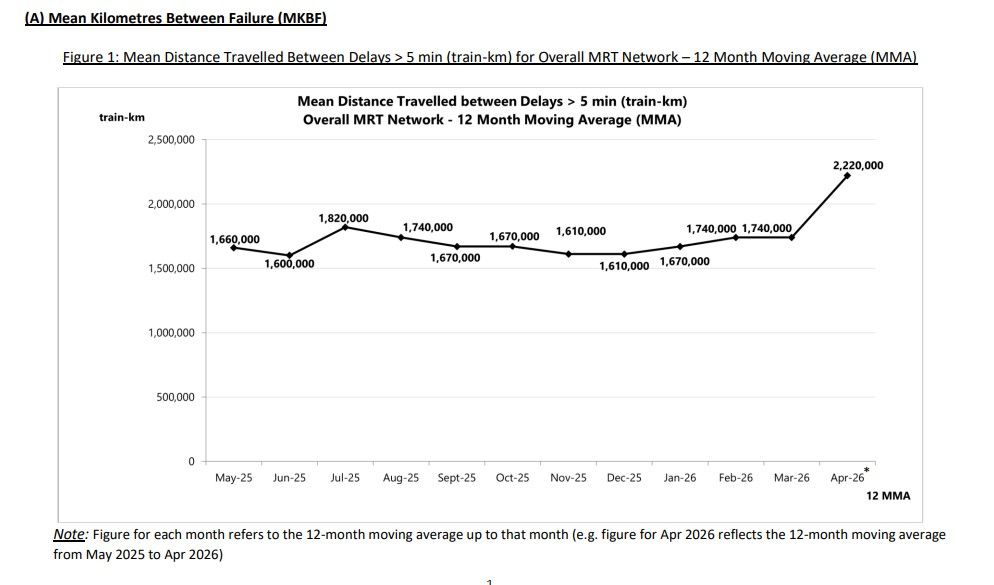
The overall MRT network’s mean kilometres between failures (MKBF) rose to 2,220,000 train-km in April, up from 1,740,000 train-km in March.
According to LTA, this marked the first time the network’s reliability metric exceeded 2 million train-km since November 2024.
MKBF measures the average distance a train travels before experiencing a delay exceeding five minutes. LTA uses a 12-month moving average to calculate the figure across the rail network.
Downtown Line drives improvement
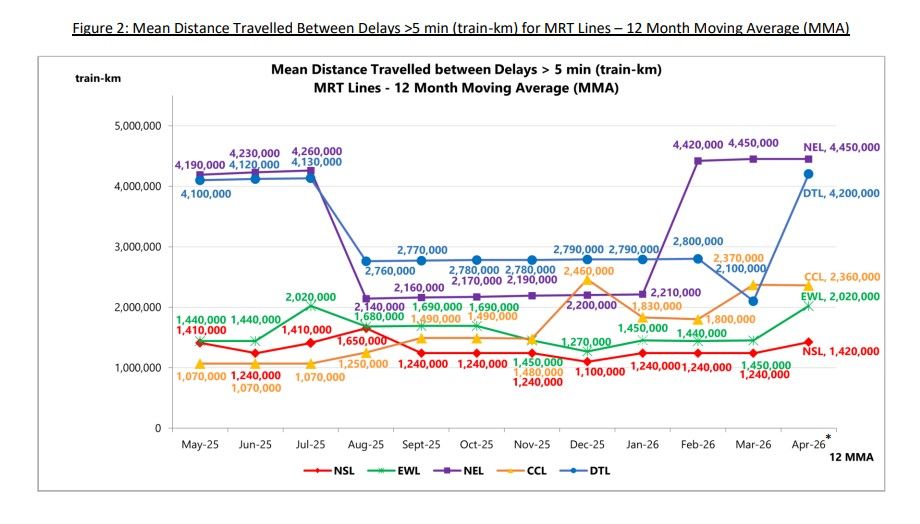
The strongest improvement came from the Downtown Line (DTL), whose MKBF doubled to 4,200,000 train-km in April from 2,100,000 train-km in March.
The DTL’s performance was the largest contributor to the network-wide increase in rail reliability during the month.
The East-West Line (EWL) also recorded stronger performance, with MKBF increasing to 2,020,000 train-km from 1,450,000 train-km previously.
Similarly, the North-South Line (NSL) improved to 1,420,000 train-km from 1,240,000 train-km.
The North-East Line (NEL) maintained its reliability performance at 4,450,000 train-km, unchanged from March.
However, the Circle Line (CCL) experienced a slight decline, with MKBF slipping to 2,360,000 train-km from 2,370,000 train-km.
LTA also reported that there were no delays exceeding 30 minutes across the MRT network in April.
The last such disruption occurred in November 2025.
Mixed results for service delivery
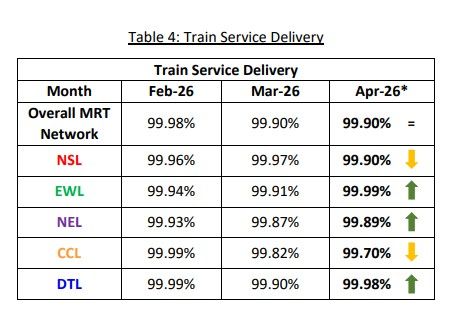
Apart from MKBF, LTA also tracks train service delivery, which measures whether trains operated according to their scheduled mileage.
The metric compares the actual distance travelled by trains against planned operational distances and expresses the result as a percentage.
April’s figures showed mixed results across the network.
The EWL, NEL and DTL registered improved train service delivery performances during the month.
However, the NSL and CCL recorded declines compared with March.
Train punctuality also improved across most MRT lines in April.
This metric measures the percentage of train trips completed within two minutes of schedule at the end of each line.
LTA said train punctuality can be affected by operational issues and service disruptions even when train services continue operating without a complete stoppage.
Lower punctuality levels can lead to longer waiting times and increased crowding due to less regular train intervals.
Most MRT lines saw better punctuality in April compared with March, with the exception of the Circle Line.
Monthly updates introduced after disruptions
LTA has issued monthly rail reliability updates since August 2025 following a series of rail disruptions that drew public attention to the MRT system’s performance.
Before that, reliability figures had been released on a quarterly basis.
The authority said the shift to monthly reporting was intended to allow greater public scrutiny of Singapore’s rail network performance.
TEL excluded from reliability report
The reliability performance of the Thomson-East Coast Line (TEL), Singapore’s newest MRT line, was not included in the monthly report.
LTA said newer rail lines typically record significantly lower mileage because ridership levels remain relatively low and trains operate less frequently compared with more established lines.
The authority added that the TEL’s reliability performance remained unstable because the line is still undergoing completion works and system integration activities alongside regular operations and maintenance.
During the same period, the TEL’s MKBF dipped slightly to 356,000 train-km from 374,000 train-km.
“LTA and the rail operator are closely monitoring the line, and will continue to work together to improve its performance and ensure smooth and reliable journeys for all commuters,” the authority said.