Online readers challenge Indranee's empathy claim, citing track record as fertility rate falls
Comments on Reddit and Mothership's Facebook page reacted sharply to Minister Indranee Rajah's podcast defence of her workgroup chairmanship, with many questioning whether empathy can substitute for parental experience and scrutinising her eight-year record overseeing Singapore's fertility portfolio.


The question of whether lived experience is necessary to understand — and shape policy on — a deeply personal challenge has dominated online reaction to remarks by Minister Indranee Rajah defending her role as chair of Singapore's Marriage and Parenthood Reset Workgroup.
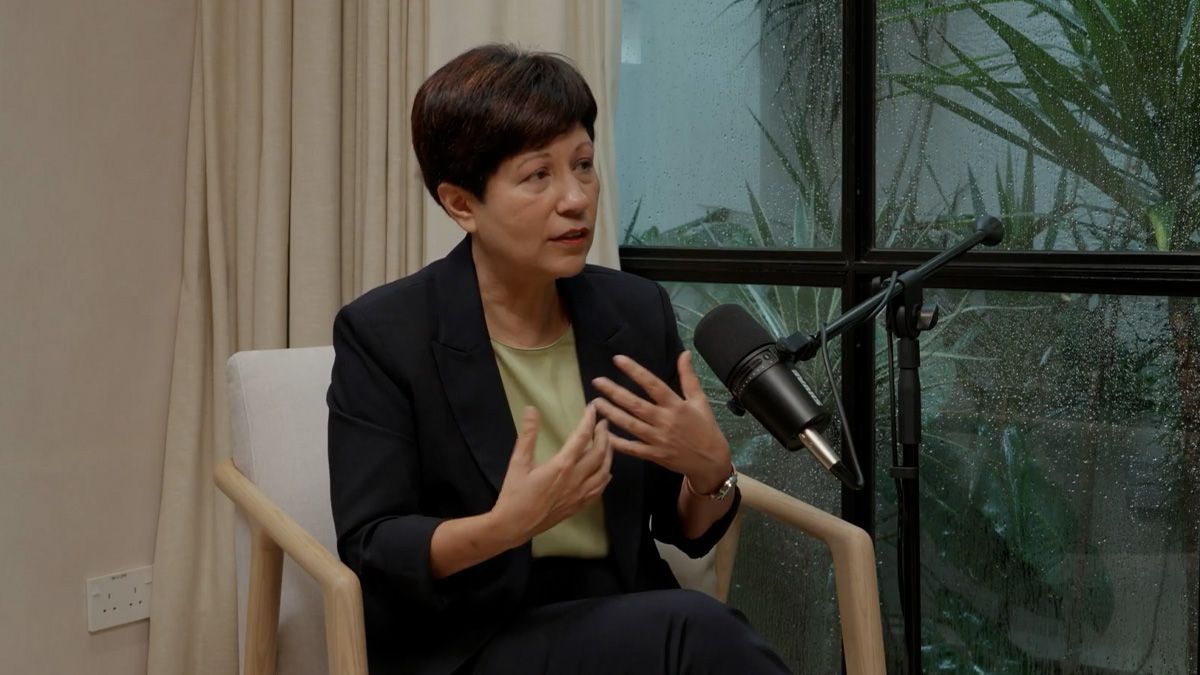
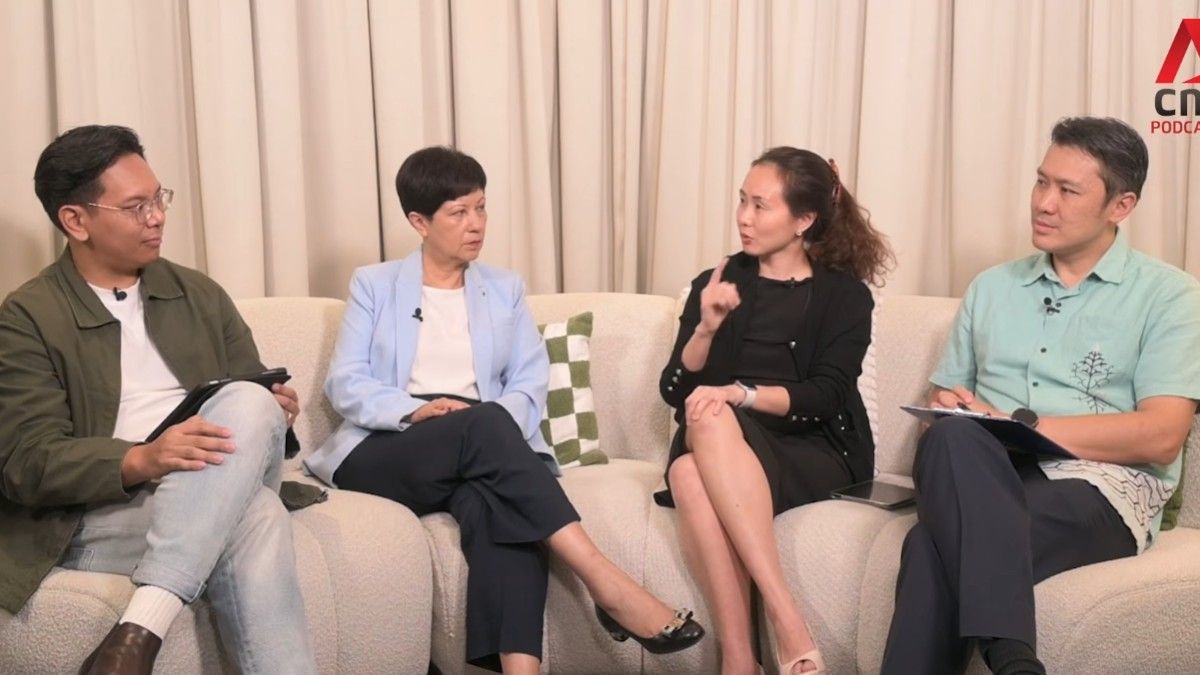
Responding to criticism of her appointment on the Who We Are podcast, Indranee argued that identical personal experience is not a prerequisite for empathy. The claim landed on Reddit and Mothership's Facebook page to a wave of disagreement — some measured, some sharp, and some pointed directly at her record overseeing Singapore's fertility figures.
The online conversation touched on several themes: the line between empathy and lived experience, analogies from other fields, her TFR record, structural barriers to family formation, and a smaller group's more measured defence of her appointment.
For background, Indranee was appointed to oversee Singapore's Marriage and Parenthood portfolio in July 2020 and has held the role since. Singapore's total fertility rate fell (TFR) from 1.10 in 2020 to a historic low of 0.87 in 2025, a continuous six-year decline. Deputy Prime Minister Gan Kim Yong described the figure as "existential" when disclosing it in parliament on 26 February 2026.
The Marriage and Parenthood Reset Workgroup was announced on 29 April 2026 by the National Population and Talent Division (NPTD), with Indranee as chair. It comprises nine political office holders drawn from the Prime Minister's Office and eight ministries. A full report is expected in early 2027.
The empathy-experience debate
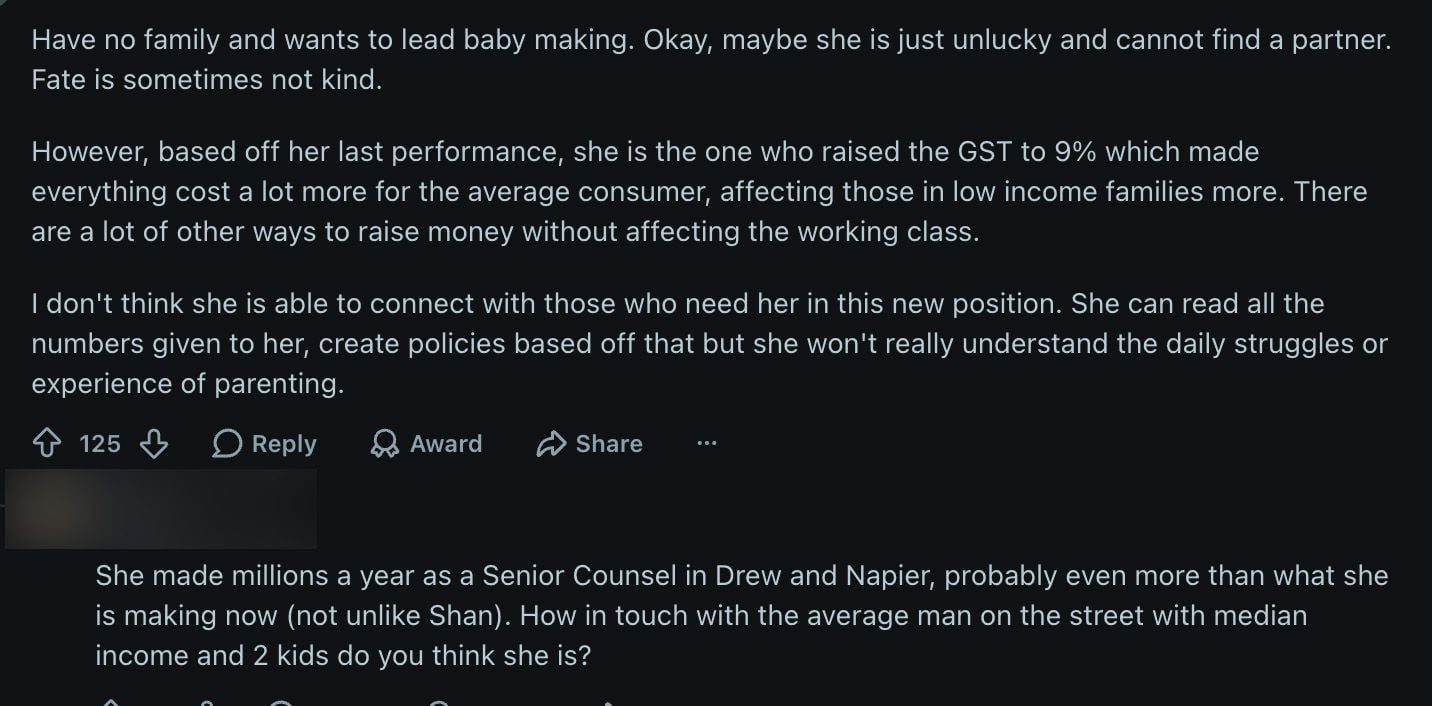
One of the most widely-upvoted responses on Reddit — gathering over 470 upvotes — challenged the framing directly. "She can have some empathy," the commenter wrote. They argued this falls short of truly knowing what parents need or want from the policies meant to support them.
A parent reflecting on their own trajectory wrote on Facebook that before having children, they believed they understood what parenthood involved. "After having kids, I realised I know too little," they wrote, describing the practical and emotional dimensions of parenthood as things that cannot fully be put into words.
Several commenters drew a distinction between empathy as a professional posture and as a lived reality. "Empathy ends once she leaves the office," one response read. They contrasted it with parenthood — which, they noted, does not pause when the working day ends.
Others raised the distinction between sympathy and empathy directly, arguing the minister had treated the words as interchangeable when they mean different things.
One response noted that high empathy is characteristic of trained counsellors with specific emotional competencies — and questioned whether those qualities had been demonstrated in the minister's public statements.
One commenter said the question was not whether empathy is possible without experience, but whether it is possible without skin in the game. They argued that for the work to carry real weight, the person leading it needed to have something personally at stake in the outcome.
The analogies
The minister's argument drew a volley of analogies from commenters seeking to illustrate the gap between claimed empathy and practical qualification.
Among the most-shared on Reddit was a comparison to hiring a technology company chief executive who has never used the company's own product. "Asking a monk to sell shampoo," offered one commenter more concisely.
A driving instructor without a licence, a piano teacher who cannot play, a coach who has never competed, and a colour-blind person describing a colour spectrum were among the other comparisons offered across both platforms.
One Facebook commenter distilled the argument into a mathematical image: gaining a family member and losing one are not the same experience — one is an addition, the other a subtraction.

The observation drew several supporting comments noting that Indranee had cited personal bereavement, not parental experience, as the basis for her claimed understanding of family.
A widely-upvoted Reddit comment applied the logic directly to hiring, saying it could equally be used by job seekers applying for roles with no relevant background.
Another on the same thread noted a pointed irony: the governing party has long defended its authority on the basis of track record and experience — and the minister was now arguing the inverse.
One commenter drew a further contrast with what they described as the minister's earlier parliamentary arguments — that administrative experience was central to questions of governance competence — and argued this sat uneasily with her current position.
Six years of data
To understand why the track record argument resonated, the numbers provide context. Indranee was appointed to oversee the Marriage and Parenthood portfolio in July 2020, when Singapore's total fertility rate stood at 1.10.
Official data shows the rate stood at 1.12 in 2021 before falling to 1.04 in 2022, 0.97 in both 2023 and 2024, and 0.87 in 2025 — the lowest figure ever recorded for Singapore.
Deputy Prime Minister Gan Kim Yong disclosed the 0.87 figure in parliament on 26 February 2026, describing the trend as "existential" for the country. The Marriage and Parenthood Reset Workgroup was announced two months later, on 29 April 2026.
One reader compiled the full year-by-year data in a detailed comment, presenting it alongside the question of whether a minister who oversaw a continuous six-year decline in her core portfolio metric is the appropriate person to lead the response. "Responsible and accountable person would have taken ownership," they wrote, asking why the decline had not prompted earlier acknowledgment or policy correction.
Others reinforced the point. One commenter asked whether the workgroup was substantively different from prior exercises, noting that the absence of any public accountability for the TFR decline made it difficult to expect different results this time.
A comment that drew significant engagement directly invoked the governing party's own framing against the minister: "PAP: Vote us because we have the track record. Indranee: Experience not required."
The observation that the party's long-standing argument for its own authority rested on precisely the credential the minister was now dismissing was a recurring thread across both platforms.
Another commenter framed it in performance terms: if the TFR is the key performance indicator, they argued, the result after six years of stewardship would in any other context warrant a consequence — not an expanded role.
The accountability question
A distinct thread of comments challenged the appointment on grounds of consistency rather than personal circumstance.
One commenter pointed to what they described as the minister's earlier parliamentary arguments about the Workers' Party's lack of administrative experience — specifically, arguments made over several years that the party could not be trusted to manage a town council partly because it lacked relevant experience. They argued this position sat uneasily with her current defence that experience is not a prerequisite for empathy or effective leadership.
Another said the question was not whether empathy is possible without experience, but whether it is possible without skin in the game. They argued that for the work to carry real weight, the person leading it needed to have something personally at stake in the outcome — and that no such stake was visible.
Several commenters questioned why the continuous TFR decline had not prompted any visible change in approach or leadership, with one asking directly whether the portfolio had produced any results under her stewardship and whether that record had been addressed publicly.
Others argued that the response to public criticism had been to reaffirm the minister's position rather than engage with the substance of the concerns raised. One described the approach as reflecting a "we know better than you" attitude, while another noted that the original criticism had been measured — and that the response of dismissing it had only reinforced the concern it raised.
Structural barriers, not mindset
A theme that emerged in more analytical responses was that framing low fertility as a mindset problem misses the concrete barriers deterring family formation.
One highly-upvoted commenter described the actual calculus facing young Singaporeans: housing timing, flat prices, childcare availability, job insecurity, the demands of caring for ageing parents, educational pressures, and burnout. "People don't need another reminder that family is meaningful," they wrote, arguing that what is needed is for family formation to stop feeling like a luxury project.
Others reinforced the point. One noted that rising HDB flat prices sit uncomfortably alongside government appeals for Singaporeans to consider starting families.
A Facebook commenter argued that meaningful change would require reducing working hours, making housing affordable for single-income families, and addressing job insecurity — before any shift in sentiment could reasonably be expected.
Another observed that parenthood, unlike most life decisions, is irreversible. The argument that people should "give it a chance" therefore misunderstands the calculus — people are not undecided out of ignorance, but because the support structures are not yet convincing enough to justify the commitment.
One response argued that the framing of "mindset reset" substitutes a communications exercise for the harder choices structural reform would require, and that the response to public scepticism had been to double down rather than engage with the substance.
The 'detour' remark
Indranee's earlier use of the word "detour" to describe career breaks for parenthood — clarified in the podcast as meaning a pause rather than a wrong path — was cited by several commenters as evidence of the gap they were describing.
"No, actually you need experience in this case to empathise," one commenter wrote. They argued that without having gone through parenthood, certain phrasings reveal an underlying gap that the minister's clarification did not close.
Others on Facebook made the same observation in different terms, noting that those with parental experience would not reach instinctively for language that frames child-rearing as a professional deviation — however it was later explained.
Voices of nuance and support
Not all responses were critical. One commenter cautioned against reducing the question to marital status alone, describing it as a form of bias that judges a woman by personal life choices rather than her professional record. They argued that dismissing the minister's capability on those grounds was itself a retrograde position.
"The real question isn't whether she has the capacity to empathise with parents," this commenter argued, but whether she had demonstrated genuine understanding of their concerns beyond formulaic responses.
Others pointed to the workgroup's composition as a partial answer to the lived-experience concern. A reader who listed the full membership noted that all eight other members are parents — several with three or more children. They suggested the group itself is not lacking in parental experience, whatever concerns exist about the chair.
One commenter drew a parallel to medical practice, arguing that professional expertise can exist independently of personal experience.
Another offered a more structural critique, saying the more relevant concern was not single status but the class and lifestyle distance between senior ministers and the households they seek to influence — a gap that exists regardless of marital status.
The baby bonus remarks
Comments on Indranee's remarks about the baby bonus for children of unwed mothers were also largely unfavourable. Several readers described the "societal values" framing as evasive.
One commenter said they were less concerned about the minister's personal circumstances than about what they described as the government's failure to give a direct answer on extending support to single Singaporean parents — describing it as "straightforward stuff" that should not require such qualification.
Others pointed to the minister's closing language — that the government "will continue to look at this" — as characteristic of a broader pattern in official responses on fertility policy. Phrases such as "monitor", "look at" and "see what can be done" had appeared in official statements on fertility for years, several commenters noted, without producing concrete commitments.