Trump vows to continue Iran war, rules out Kurdish involvement and dismisses Larijani threats
US President Donald Trump has vowed to press on with military strikes against Iran, offering a vague definition of "unconditional surrender" while ruling out Kurdish involvement and dismissing threats from Iranian official Ali Larijani during a CBS News interview on Saturday.
- Trump defines "unconditional surrender" vaguely, saying Iran must "cry uncle or can't fight any longer."
- Trump rules out Kurdish forces joining the conflict despite CIA arms reports and open US ground troop possibility.
- Iran's President Pezeshkian issued, then retracted, a video apology for retaliatory strikes on Gulf states.

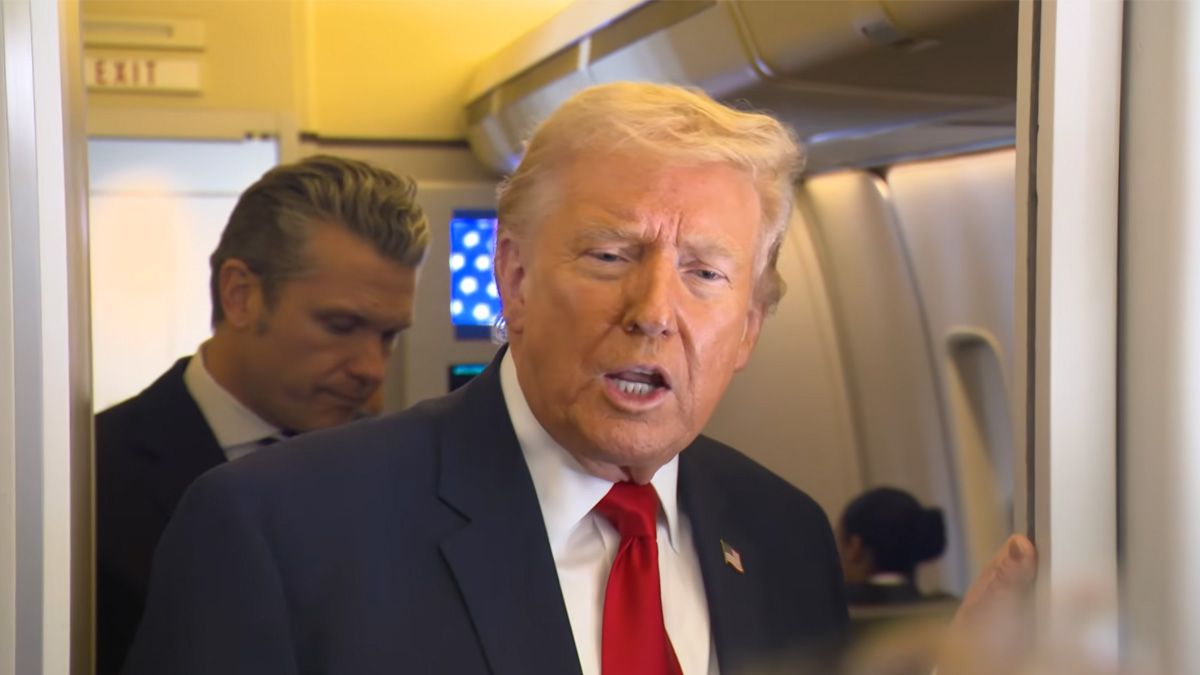
US President Donald Trump vowed on Saturday to continue military strikes against Iran until the country's leadership submits to what he described as "unconditional surrender," while ruling out the use of Kurdish forces as a ground proxy and leaving open the possibility of deploying American troops at a later stage.
Speaking to reporters aboard Air Force One, Trump offered an ambiguous definition of his stated war aim.
"I said unconditional. It's where they cry uncle or when they can't fight any longer and there's nobody around to cry uncle — that could happen too," he said, when pressed for specifics.
The vague response has continued to frustrate observers and officials seeking clarity on the administration's political endgame in Iran, including what role, if any, the United States would play in determining who leads the country after the conflict.
Trump rules out Kurdish involvement
Despite reports that the CIA had armed Kurdish forces, Trump said he had personally intervened to prevent them from joining the offensive. "I don't want the Kurds going in. They're willing to go in, but I've told them I don't want them going in. The war's complicated enough without getting the Kurds involved," he said.
On the question of US ground forces, Trump indicated that deploying troops to secure enriched uranium believed to be stored at Iranian nuclear sites remains a possibility, though not an immediate one.
"We haven't talked about it. At some point maybe we will. It would be a great thing. Right now we're just decimating them," he said. "We wouldn't do it now."
Dignified transfer at Dover air force base
Earlier on Saturday, Trump travelled to Dover Air Force Base in Delaware to attend the dignified transfer of six US service members killed in the opening days of the conflict. Vice President JD Vance and Defence Secretary Pete Hegseth accompanied him.
Under an overcast sky, Trump saluted each of six flag-draped transfer cases as they were carried into waiting vans. He told reporters afterwards that the ceremony had not caused him to reconsider the military campaign.
"No, we're winning the war by a lot. We decimated their whole evil empire. It will continue I'm sure for a little while but I'm very proud of the people," he said. He later added that casualties were "a part of war."
The conflict began one week ago, when Trump authorised US forces to join Israel in conducting airstrikes against Iran. Among those killed in the early strikes was Supreme Leader Ayatollah Ali Khamenei, who died on 28 February during a meeting with senior officials at a compound in Tehran.
School strike controversy
Trump also addressed the destruction of a girls' elementary school in southern Iran, which killed at least 175 people, many of them children. He attributed responsibility to Iran.
"No, in my opinion, based on what I've seen, that was done by Iran," Trump said. "They're very inaccurate as you know with their munitions. They have no accuracy whatsoever."
His assertion came despite forensic analysis conducted by The New York Times, CNN, and the Associated Press, which assessed with a high degree of likelihood that the strike was a precision US attack, occurring at the same time as operations against an adjacent Islamic Revolutionary Guard Corps (IRGC) naval base.
A Pentagon investigation remains ongoing. Defence Secretary Hegseth declined to endorse Trump's claim, stating only that the matter was under investigation.
Trump dismisses Larijani threats
In a separate phone interview with CBS News late on Saturday evening, Trump dismissed threats issued by Ali Larijani, secretary of Iran's Supreme National Security Council and a close confidant of the late Khamenei. Larijani had posted on social media earlier that day warning Trump must "pay the price" for US-Israeli strikes on Iran.
Larijani has become one of Iran's most prominent public figures since Khamenei's killing and has been widely regarded as a leading voice in Tehran's diminished leadership structure.
"I have no idea what he's talking about, who he is. I couldn't care less," Trump told CBS News, adding that Larijani had "already been defeated."
Trump also sought to frame Larijani's earlier regional posture as an admission of failure.
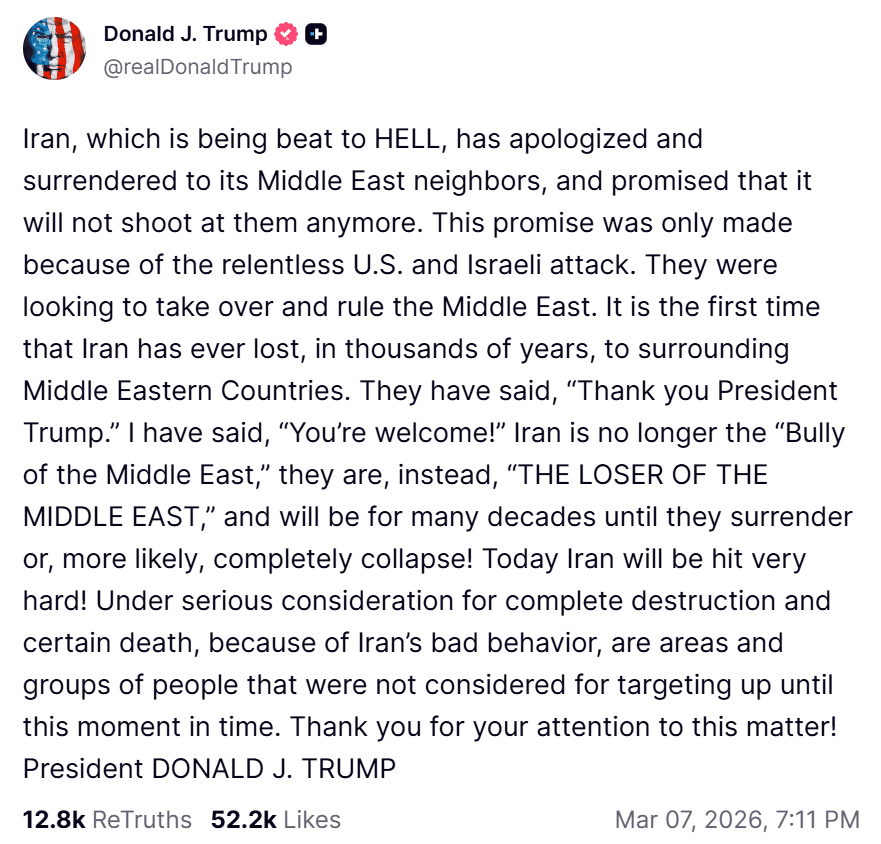
"He's already surrendered to all of the Middle Eastern countries because he was trying to take over the entire Middle East. That's why all of those rockets were long ago aimed at those countries. He had that planned, long before this started," the president said.
Prior to the CBS News interview, Trump had posted on his Truth Social platform warning that more Iranian officials would become targets, stating: "Today Iran will be hit very hard!"
He reiterated to reporters aboard Air Force One that he had no intention of entering into negotiations with the Iranian government, and that the war would end only once Tehran no longer possessed a functioning military or any remaining leadership.
Iranian president retracts apology
Earlier on Saturday, Iranian President Masoud Pezeshkian released a video in which he appeared to apologise to Iran's neighbours for retaliatory strikes conducted against Israel and US military bases in the Middle East. He indicated that Iran would cease striking other Persian Gulf states unless it was attacked first.
Pezeshkian subsequently walked back the remarks in a follow-up post on social media.
"We have not attacked our friendly and neighboring countries. Rather, we have targeted US military bases, facilities, and installations in the region," he wrote, with no apology included.
Duration of conflict remains unclear
While Trump suggested in early interviews following the start of hostilities that the campaign would last approximately four weeks, the administration has since distanced itself from that estimate. Some officials have warned the conflict could extend for months.
On Saturday, Trump declined to give a definitive timeline. "Whatever it takes," he told reporters, even as he referred to the campaign in a separate exchange as a "short excursion."