US reports 140 troops wounded as Iran war enters 12th day
The Pentagon has confirmed 140 US service members wounded in the Iran conflict, as the White House claims operational success and Congress raises questions over war costs now estimated at US$5 billion in munitions alone.
- Pentagon confirms 140 US troops wounded, seven killed, and US$5 billion spent on munitions in two days.
- White House claims over 5,000 enemy targets struck and sharp reductions in Iranian missile and drone attacks.
- Russia denied sharing US military intelligence with Iran; Trump envoy says diplomatic solution with Tehran appears unlikely.

The Pentagon confirmed on Tuesday, 10 March 2026 that approximately 140 US service members have been wounded since the outbreak of hostilities with Iran, in the first official accounting of the broader human toll of the conflict.
Pentagon spokesman Sean Parnell said in an emailed statement that "the vast majority of these injuries have been minor," with 108 service members already returned to duty. Eight remain severely injured.
The disclosure follows a series of retaliatory rocket and drone strikes launched by Iran that resulted in the deaths of seven US soldiers stationed in Kuwait and Saudi Arabia. A Kentucky soldier was identified as the seventh fatality.
Those remarks were made on the 11th day of the conflict. The war has since entered its 12th day.
A US$5 billion opening salvo
The financial cost of the conflict has emerged as a parallel concern. An estimate submitted by the Pentagon to Congress indicates that munitions expenditure alone during the first two days of fighting reached US$5 billion.
The figure was disclosed by a person who spoke to the Associated Press on condition of anonymity following a private briefing. The estimate does not appear to include other war-related expenses beyond munitions.
The daily expenditure figure is expected to fluctuate, and the total tally is reported to be higher than projections previously offered by outside analysts.
The Trump administration has indicated it may seek supplemental war funding from Congress. However, several lawmakers have stated they would refuse to approve additional allocations for the Pentagon.
The annual Defence appropriations bill directed approximately US$838 billion to the Pentagon earlier this year. The Defence Department also received US$150 billion in supplemental funding as part of Trump's tax legislation, which was signed into law.
A diplomatic breakthrough eclipsed
The war began on 28 February 2026 — the same day Oman's Foreign Minister Badr bin Hamad Al Busaidi announced what he described as a major breakthrough from the third round of indirect US-Iran talks, held in Geneva the previous day.
Al Busaidi told CBS News in Washington that Iran had agreed in principle never to stockpile enriched uranium — a commitment he described as unprecedented in the history of negotiations over Iran's nuclear programme.
"The single most important achievement, I believe, is the agreement that Iran will never ever have nuclear material that will create a bomb," Al Busaidi said. "Now we are talking about zero stockpiling, and that is very, very important because if you cannot stockpile material that is enriched, then there is no way that you can actually create a bomb."
Al Busaidi said the agreement would include full and comprehensive verification by the International Atomic Energy Agency (IAEA), and that Iran would degrade its current nuclear stockpiles to the lowest level possible, converting the material into irreversible fuel.
"A peace deal is within our reach … if we just allow diplomacy the space it needs to get there," Al Busaidi said, adding that he believed all issues in a deal could be resolved "amicably and comprehensively" within a few months.
The diplomatic overture aligned with Trump's own stated initial objectives: pressuring Iran to abandon its nuclear and long-range missile programmes and sever support for its armed proxy forces — goals the Oman-brokered talks appeared to be advancing.
How the justification shifted
On 2 March 2026, four days after the war began, Secretary of State Marco Rubio offered what was then described as the administration's clearest public justification for its entry into the conflict.
Speaking to reporters at the Capitol ahead of a closed-door congressional briefing, Rubio said the US acted because it was certain Israel was going to strike Iran regardless, and that Tehran would have responded by targeting American forces across the region.
"We knew that there was going to be an Israeli action," Rubio told reporters. "We knew that that would precipitate an attack against American forces, and we knew that if we didn't pre-emptively go after them before they launched those attacks, we would suffer higher casualties."
Rubio was joined at the briefing by CIA Director John Ratcliffe and Joint Chiefs of Staff Chair Dan Caine, who addressed lawmakers behind closed doors ahead of an expected vote in the House of Representatives on a war powers resolution.
By Tuesday, 10 March, White House press secretary Karoline Leavitt offered a different framing.
She stated that Trump's decision was based on intelligence indicating an imminent Iranian attack on the United States itself — with no reference to the Israeli trigger Rubio had cited over a week earlier.
"Iran chose this path," Leavitt said, adding that Trump "was not going to sit back" and permit such an attack to proceed. She did not elaborate on the specific nature of the intelligence cited.
Iranian Foreign Minister Abbas Araghchi rejected the administration's stated rationale outright. "The claim that Iran was planning on attacking the US or US Forces, whether preventively or pre-emptively, is a sheer and utter lie," Araghchi said in a post on X.
Araghchi dismissed the military campaign as "Operation Epic Mistake, a misadventure engineered by Israel and paid for by ordinary Americans" — a pointed reference to the US military's own designation for the operation, Operation Epic Fury.
White House declares 'resounding success'
Leavitt told reporters on Tuesday that the US military is achieving its objectives faster than anticipated under Operation Epic Fury.
"More than 5,000 enemy targets have been struck so far. Iran's ballistic missile attacks are down more than 90%, and their drone attacks are down by approximately 85% since the start of Operation Epic Fury," Leavitt said.
When asked to provide a timeline for the conclusion of the operation, Leavitt said the decision rests solely with Trump, and that military activity would cease only upon the "unconditional surrender" of the Iranian regime.
Leavitt clarified that such a "surrender" need not be formally declared by Tehran. Instead, she said the determination would be made by the US government when it concludes that Iran no longer poses a "credible threat."
Rubio had cited two specific objectives: the destruction of Iran's ballistic missile capability and its navy. Trump has outlined broader goals in recent interviews, including preventing Iran from developing a nuclear weapon and severing Tehran's support of proxy forces in the region.
Toll on both sides
The air campaign has killed several of Iran's top military and political leaders, including Supreme Leader Ayatollah Ali Khamenei. The Iranian Red Crescent Society has reported that more than 500 people have been killed in Iran.
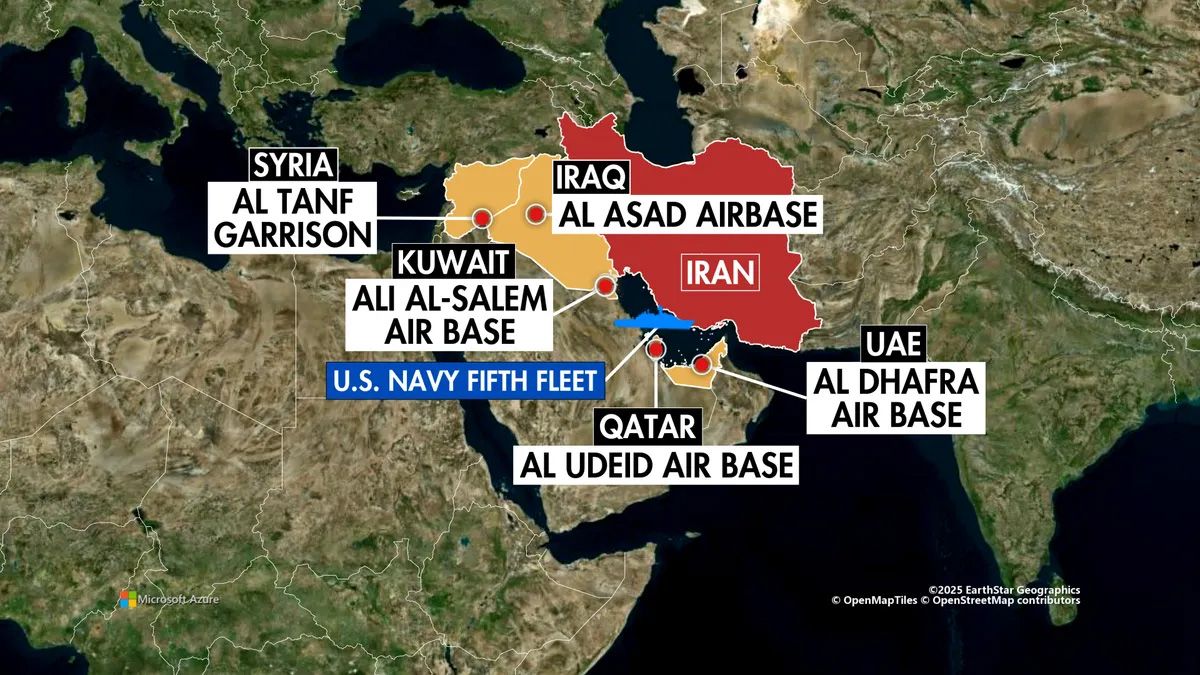
The US military confirmed its death toll had risen to six following the recovery of two bodies from a regional facility struck by Iran, prior to confirmation of the seventh fatality. Iran retaliated against joint US-Israeli strikes with waves of drone and missile attacks across the Middle East, targeting US bases and assets including in the Gulf.
Israel has received at least US$21 billion in military aid from Washington since 2023.
Investigation ongoing into school strike
Questions also persisted on Tuesday over a strike on 28 February 2026 that killed at least 168 children and 14 teachers at the Shajareh Tayyiba elementary school in Minab, southern Iran. The White House said on Tuesday that the Pentagon would release its investigation into the strike.
Trump last week blamed Iran for the attack, repeating the claim on Monday and asserting that Iran possessed Tomahawk cruise missiles — a claim multiple munitions experts have disputed, saying Iran does not hold such weapons.
Defence Secretary Pete Hegseth declined to confirm Trump's assertion, telling reporters the US was still investigating. Analysis by CNN of missile fragments displayed at the school site, and a separate review by rocket expert Markus Schiller of the Stockholm International Peace Research Institute, indicated the debris was consistent with a US-made Tomahawk cruise missile.
A fragment marked "Made in USA" bearing the name of Ohio-based manufacturer Globe Motors, and another marked "SDL ANTENNA" bearing the name of Colorado-based Ball Aerospace, were among the remnants pictured. The Pentagon has not commented on the fragment analysis.
Iran disputes casualty figures and condemns UN silence
Iran's ambassador to the United Nations, Amir-Saeid Iravani, criticised the UN Security Council on Tuesday for what he described as its "silence" over the conflict, saying it was "regrettable" that the council was "turning a blind eye despite its responsibility under the charter to maintain international peace and security."
Iravani said nearly 10,000 civilian sites have been struck, including approximately 8,000 residential homes, and put the overall death toll at more than 1,300 people — a figure significantly higher than the 500 reported by the Iranian Red Crescent Society cited earlier in the conflict.
"Today, it is Iran, tomorrow it could be any other sovereign state," Iravani said, urging the international community to act. He called on UN member states to condemn what he described as US-Israeli "aggression" that "poses a serious threat" to international law.
Congress divided along party lines
Reactions to the administration's justifications have split sharply along party lines.
Senate Democratic Minority Leader Chuck Schumer said before a closed-door briefing that he regarded the conflict as a war of choice. After the session, he described the officials' responses as "completely and totally insufficient" and said the meeting raised more questions than it answered.
Democratic Senator Mark Warner, vice-chair of the Senate intelligence committee, said he was concerned about the precedent of allowing Israel to draw the United States into a new conflict.
"There was no imminent threat to the United States of America by the Iranians. There was a threat to Israel," Warner said. "If we equate a threat to Israel as the equivalent of an imminent threat to the United States, then we are in uncharted territory."
Warner called on Trump to articulate a specific objective, an exit plan, and the legal basis for the conflict.
Senator Richard Blumenthal, Democrat of Connecticut, echoed those concerns after a separate classified briefing before the Senate Armed Services Committee. His principal concern is the potential deployment of American ground troops, and he expressed alarm over possible Russian and Chinese assistance to Tehran.
"The American people deserve to know much more than this administration has told them about the cost of the war, the danger to our sons and daughters in uniform, and the potential for further escalation," Blumenthal said.
Russia denies sharing intelligence with Iran
US special envoy Steve Witkoff said on Tuesday that Russian officials denied, in a phone call with Trump on Monday, that they are sharing intelligence on US military assets with Iran.
Trump spoke with Russian President Vladimir Putin on Monday for approximately one hour. Witkoff, speaking in an interview with CNBC, said of the denial: "We can take them at their word. That's a better question for the intel people, but let's hope that they're not sharing."
Witkoff also indicated that Trump remains open to dialogue with Iran, but expressed scepticism about Tehran's willingness to pursue a diplomatic resolution.
"I think the president is always willing to talk, but the question is whether it would be productive or not," Witkoff said. "Do they actually want to have a diplomatic solution here? And so far the evidence suggests no."
Iran rules out ceasefire
In Tehran, Speaker of Iran's parliament Mohammad Bagher Ghalibaf stated on Tuesday that the Islamic Republic is not seeking a ceasefire and that "the aggressor must be punished."
In a post on X, Ghalibaf said Iran would break what he described as Israel's "vicious cycle of war, negotiations, ceasefire, then war again."
His remarks signal that Iran intends to continue its engagement with the conflict on its own terms, rejecting diplomatic off-ramps being discussed in some international quarters.