KF Seetoh urges empathy and restraint amid F&B hardship over S$2 outside drinks charge controversy
Singapore food advocate KF Seetoh calls for empathy after a Geylang eatery faced backlash over a S$2 charge for outside drinks, warning against online outrage harming small businesses.

- KF Seetoh urged respect for F&B rules and warned against online backlash harming small businesses.
- A Geylang eatery faced review bombing after a S$2 outside drink charge dispute.
- The incident sparked debate on consumer rights, media responsibility, and social media toxicity.

Singapore food advocate KF Seetoh has urged empathy and restraint following recent online backlash faced by a Geylang restaurant after a customer disputed a S$2 charge for children drinking their own water.
The incident has sparked widespread debate across Singapore.
“We can do better. We needn't be like other countries and jump in and attack our SMEs eateries already struggling in the most costly country in the world. Worse, kick them when they trip and fall,” he said.
Seetoh’s remarks came amid growing scrutiny of the incident, which has drawn sharp reactions online and prompted discussions about business practices and consumer expectations.
In a Facebook post on 15 April 2026, the founder of Makansutra said: “You have to respect rules, every eatery is merely trying to survive today. The sign, even if it's not an A0 size notice and in your face, should be respected.”
He added that eateries have the right to enforce their own policies.
“They have that right to ask of you. They seek the same respect as do other world class eateries that even ask for proper dress code and no children.”
Seetoh emphasised that customers should approach such situations with courtesy. “It's their place of business, not your trash yard. If you have to break their rules, do what polite folks do.. ask.”
He criticised what he described as entitlement among some customers. “Don't deploy your entitled attitude and destroy their livelihood with your keyboard drone missiles and stand proud that you flushed them down.”
Criticism of media coverage
Seetoh also took aim at what he described as sensationalist media coverage, accusing some outlets of amplifying a single complaint without balance and fuelling unnecessary backlash.
“And these fire starter ambulance chasing media that fanned the story, you are worse,” he said.
“You mothered a warship to join in the fray without analyzing the situation nor respect for yourselves.”
He further criticised the focus on a single perspective.
“You take one comment and set it on fire. What about the many others who feel differently.”
Seetoh warned that such approaches could have broader consequences. “If your business model is just views, your dead end is around the corner. You power without control is violent and harms society.”
Community response and broader concerns
Seetoh highlighted the reputational impact on the eatery.
“You too wouldn't like your guest to tell the world how bad your house looks and how it reeked after a visit.”
He also defended the establishment’s standing. “And BTW, Eat First or Sik Wai Sin is a legend brand that serves some stunning and rare cantonese fare and last of the few true no frills cantonese restaurants around.”
Calling for greater understanding, he added: “Just be considerate will y'all?. These are tough times and don't throw that boomerang at others.”
He extended his criticism to those amplifying the controversy.
“And stop stomping and fueling such fire on the industry which funds your operation. Be more responsible, not predictable.”
Seetoh referenced another case, saying: “You have already harmed that Toa Payoh yong tau foo stall. You should be ashamed.”
He concluded with a broader appeal. “Just be mindful everyone. This world is at war, we should look out for each other.”
In the comment section, Seetoh sarcastically suggested that F&B businesses should "have a platform that rate reviewers too. "

Public reactions remain divided
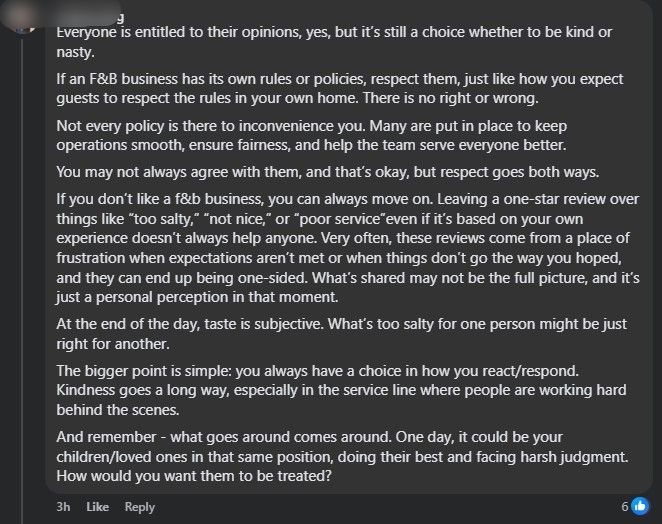
Some comments on Seetoh’s Facebook page sided with the restaurant, arguing that its no-outside-drinks policy was clearly posted and should be respected, just as one would respect rules in someone else’s home.
They argued that not all policies are meant to inconvenience customers, and if diners are unhappy, they can simply choose to go elsewhere instead of leaving harsh, one-sided reviews.
Many also emphasised the importance of kindness and understanding, noting that service staff work hard and deserve fair treatment.
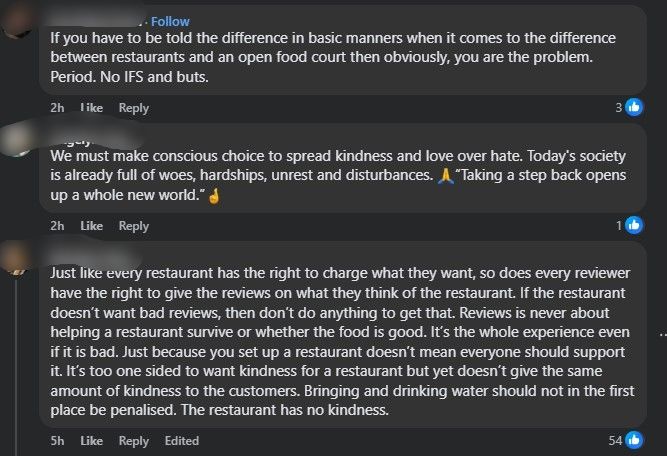
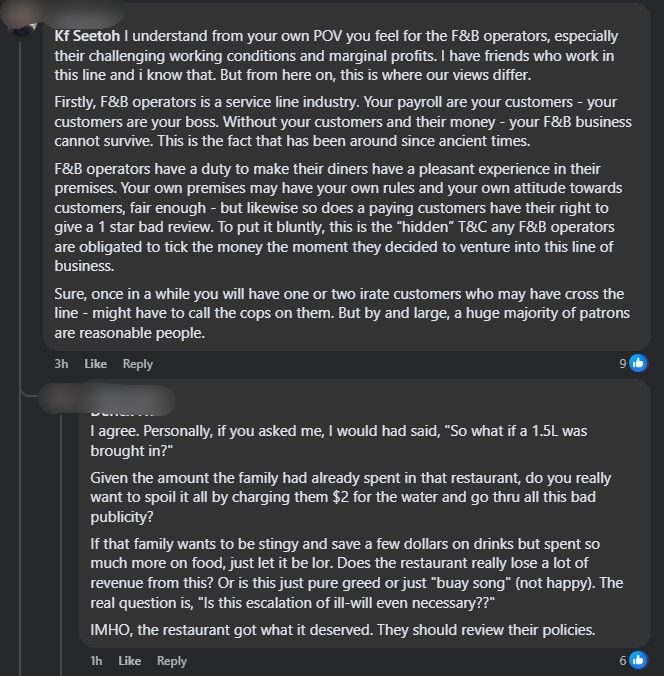
Others strongly disagreed, feeling that charging children for drinking plain water was petty and showed poor customer service.
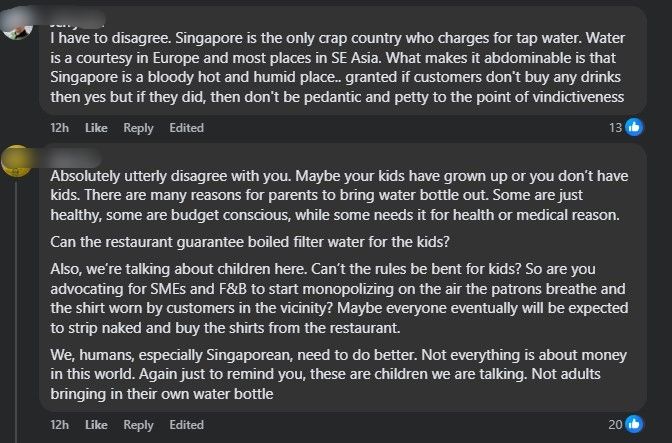
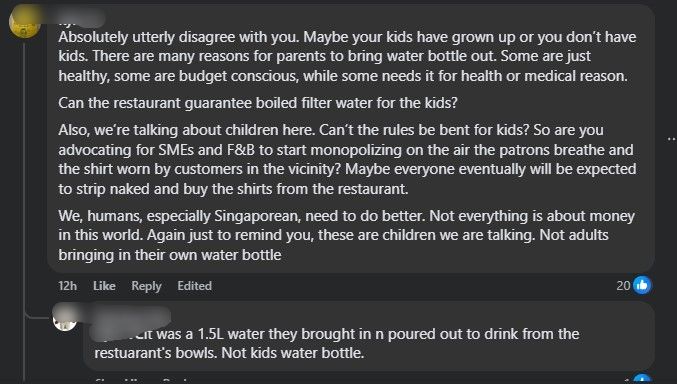
A comment disagreed with Seetoh, arguing that parents may bring water for valid reasons such as health, cost, or children’s needs, and questions whether the restaurant can ensure safe alternatives like boiled or filtered water.
The comment contend that rules should be applied with flexibility for children, warning against overly rigid policies driven by profit and urging a more humane, considerate approach.
According to The Straits Times, the owner’s wife, Julia Hsieh, shared closed-circuit television footage of the incident.
The footage showed the family arriving at approximately 8.15pm, accompanied by a domestic helper who placed a 1.5-litre bottle of mineral water on the table.
Staff reportedly reminded the group multiple times that outside drinks were not permitted.
Despite the reminders, the helper opened the bottle and poured water into a bowl for the children.
Some criticised Mothership for what they saw as irresponsible reporting that fuelled unnecessary outrage and harmed a small business.
They also defended Eat First, praising it as one of the few remaining authentic Cantonese eateries and urging critics to appreciate its traditional dishes before passing judgment.
Several people condemned the coordinated one-star review bombing as disproportionate and dishonest, pointing to the rapid decline in the eatery’s online ratings.
Others acknowledged that both sides had valid points but urged flexibility from the restaurant, noting that the issue touched on consumer rights, business survival, social media toxicity, and the responsibility of both customers and the media.
Seetoh’s remarks came after the February 2026 incident drew widespread attention following a report by Mothership.
Within a day of the report, the eatery’s Google rating plunged from 4.2 to 2.4 amid a surge of negative reviews.
However, it has since rebounded to 3.8 as of 16 April.
The customer argued the charge was unreasonable, especially as they had ordered drinks.
The restaurant maintained that the rule had been clearly communicated and enforced consistently.
While some criticised the policy as overly rigid, others said the backlash was excessive and risked unfairly damaging a small business already coping with rising costs and reputational pressures.