"Sounds good to me": How Trump chose this war, and why it cannot end
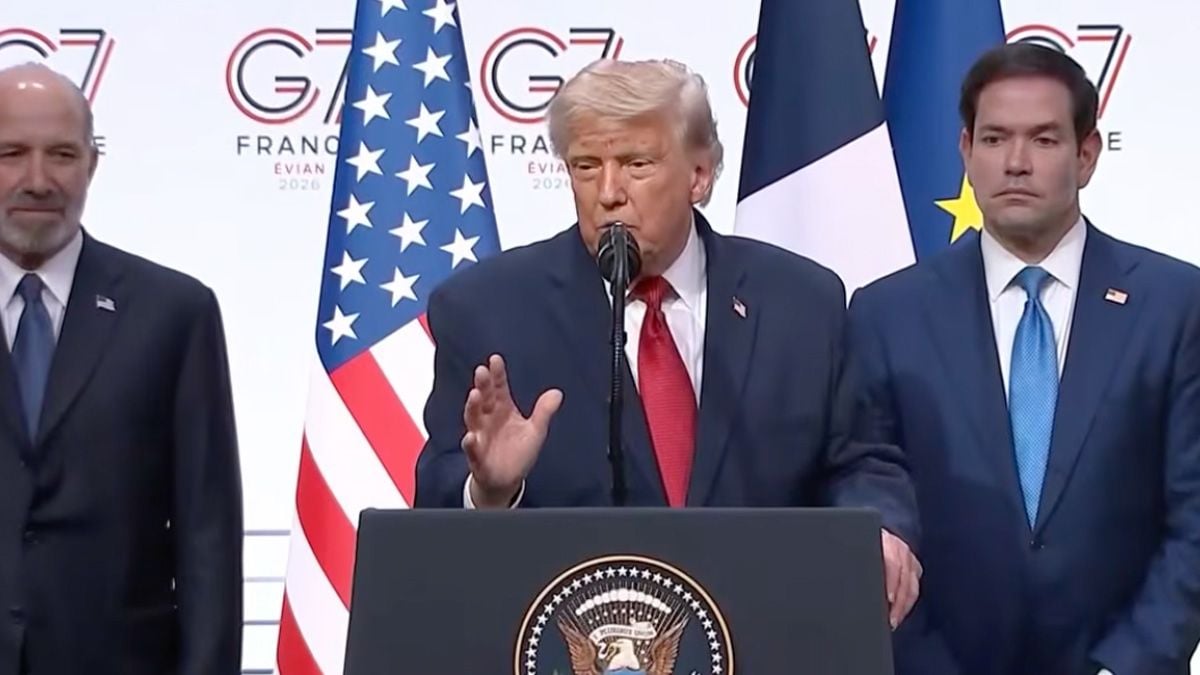
On 11 February, Netanyahu presented Trump with a regime change plan his own CIA director called "farcical" and his Chairman of the Joint Chiefs said was "standard operating procedure for the Israelis — they oversell." Trump heard all of it. Then he said four words: "Sounds good to me." What followed was not a miscalculation. It was a choice.


On the morning of 13 April, US Central Command announced a naval blockade of all Iranian ports, targeting in its own language "vessels of all nations" interacting with Iranian maritime infrastructure. The announcement came hours after Vice President JD Vance left Islamabad without a deal, following 21 hours of direct US-Iran negotiations that produced nothing.
The same administration that had described those talks as "very friendly" committed, by the following morning, to an act of naval coercion against neutral third-country shipping that most international legal scholars would struggle to justify under the laws of armed conflict.
This was not an accident of miscommunication or a sudden change of heart. It was the logical destination of a journey that has been visible since before the first bomb fell on 28 February — a journey defined not by American deception or Israeli manipulation of a passive president, but by a president whose hawkish instincts on Iran were consistent, documented, and entirely his own, and who chose to proceed with a war after being told by his own intelligence director that half the pitch justifying it was farcical.
We have argued in previous analysis that the structural conditions for this war were set long before Islamabad, and that the failure of the negotiations was predictable from the architecture of the conflict itself.
The New York Times' account of internal White House deliberations, published on 7 April, now provides the primary sourcing that confirms and deepens that argument at every critical point.
THE SITUATION ROOM AND THE CHOICE THAT WAS MADE
Our core analytical position has been that this war was not primarily a story of United States President Donald Trump being misled — by Israeli Prime Minister Benjamin Netanyahu, by Jared Kushner (son-in-law of Trump) or by Israeli intelligence assessments. It is a story of a president whose own view of Iran aligned with Israeli maximalist objectives across two administrations, and who made a choice with open eyes.
The New York Times confirms this directly. On 11 February, Netanyahu delivered a Situation Room presentation built around four propositions: Iran's ballistic missile programme could be destroyed in weeks; the regime would be so weakened it could not block Hormuz; street protests would resume; and with Mossad helping to foment rebellion, bombing could create conditions for regime change. The pitch included a video montage of potential successor leaders, among them Reza Pahlavi, the exiled son of Iran's last shah.
Trump's response, according to the Times, was four words: "Sounds good to me."
The following day, in a meeting attended only by American officials, the US intelligence community delivered its assessment. Central Intelligence Agency (CIA) Director John Ratcliffe called the regime change scenarios "farcical." Secretary of State Marco Rubio cut in: "In other words, it's bullshit."
Then General Dan Caine, Chairman of the Joint Chiefs, offered the assessment that the Times reports as follows: "Sir, this is, in my experience, standard operating procedure for the Israelis. They oversell, and their plans are not always well-developed. They know they need us, and that's why they're hard-selling."
Trump heard all of this. He processed it. He set aside the regime change objectives, called them "their problem," and remained focused on killing the supreme leader and dismantling Iran's military. The CIA director's "farcical" assessment did not stop the war. It narrowed the stated objectives while leaving the decision to proceed intact.
This is precisely the dynamic we argued needed to be understood correctly. Trump was not seduced by a pitch he lacked the basis to evaluate. He was a willing participant whose Iran hawkishness was real — shaped across decades by his view of the Islamic Republic as a uniquely dangerous adversary, compounded by Iran's documented plots to kill him in revenge for the Suleimani assassination, and reinforced by his confidence in US military capability after operations like the January Maduro capture. The Times makes clear that Netanyahu's pitch landed on ground already prepared for it.
General Caine also warned, in the days of deliberation that followed, that a major campaign against Iran would drastically deplete American weapons stockpiles — including missile interceptors already strained from years of support for Ukraine and Israel — with no clear path to replenishment. He flagged the enormous difficulty of securing Hormuz and the risks of Iran blocking it. Trump dismissed that possibility, assuming the regime would capitulate before it came to that.
The Times' account of Caine's role is revealing: he would constantly ask "and then what?" but Trump would often hear only what he wanted to hear. The man who raised the Hormuz risk most clearly was also the man least able to make his warning stick.
Crucially, the Times reports that the two officials who would need to manage the largest supply disruption in the history of the global oil market — Treasury Secretary Scott Bessent and Energy Secretary Chris Wright — were excluded from the war planning entirely. The people who would have asked most urgently "and then what?" were not in the room when the question needed answering.
THE GENEVA WINDOW AND WHO CLOSED IT
Before the bombs fell, there was a diplomatic track that, by every independent account, was close to producing an agreement. We have argued that this track was not abandoned because it failed — it was abandoned because its success would have been strategically inconvenient for the party whose objectives were driving the military timeline.
On 27 February, Omani Foreign Minister Badr Albusaidi stated publicly on CBS News that a peace deal was within reach. Iran had agreed it would never possess nuclear material capable of producing a bomb. Existing enriched uranium stockpiles would be blended down, converted into fuel, and made irreversible. Full IAEA access. Zero accumulation. Full verification. Technical talks were scheduled for Vienna on 2 March.
That same week, Jared Kushner and Steve Witkoff called from Geneva, where they had been leading negotiations. The New York Times reports that at one point they had offered Iran free nuclear fuel for the life of its programme — a test of whether Tehran's insistence on enrichment was about civilian energy or weapons capability. The Iranians rejected the offer, calling it an assault on their dignity. Kushner told Trump the Iranians were "basically playing games," that even an Obama-style deal would take months, and that he could not look the president in the eye and tell him they could solve the problem.
Eight days after the Omani foreign minister's public statement that an agreement was days away, the bombs fell.
The Guardian's account of the Geneva process adds the essential corroborating assessment. A diplomat with direct knowledge of the talks told the paper: "We regarded Witkoff and Kushner as Israeli assets that dragged a president into a war he wants to get out of." Britain's national security adviser Jonathan Powell, who was also present, assessed Iran's nuclear proposal as substantive enough to keep diplomacy alive.
The public justification for the war — that Iran was on the verge of an imminent attack on US forces — was directly contradicted by US intelligence within days of the first strikes. Administration officials told congressional staff that intelligence did not suggest Iran was preparing a preemptive strike.
CNN reported that officials acknowledged Iran was not planning to strike US forces unless Israel attacked first. Senator Mark Warner, the top Democrat on the Senate intelligence committee, was unequivocal: he saw no evidence of any imminent Iranian preemptive strike. The imminent attack was in Kushner's briefing to Trump. It was not in the intelligence.
The financial context for Kushner's role is relevant, though not the primary story. His firm Affinity Partners received US$2 billion from Saudi Arabia and more than US$200 million from the UAE. Whether he was acting on Israeli strategic alignment, financial self-interest, or ideological conviction, the American public and allied diplomats in the room had no mechanism to know whose interests he was actually representing. He was never required to disclose these relationships. He was never required to recuse himself.
VANCE: THE MOST PRESCIENT VOICE, SENT TO CLEAN UP THE MESS
The New York Times account of JD Vance's role in the pre-war deliberations reframes his Islamabad mission in a way that should not be overlooked. Nobody in Trump's inner circle, the Times reports, was more worried about the prospect of war with Iran, or did more to try to stop it, than the Vice President.
Vance warned that a war against Iran could cause regional chaos. He warned it could break apart Trump's political coalition and be seen as a betrayal by voters who had been promised no new wars. He warned that no military intelligence could truly gauge what Iran would do in retaliation when regime survival was at stake. And he warned specifically — more precisely than anyone else in the room — that Iran held the advantage when it came to Hormuz, and that if the strait was choked off, the domestic consequences would be severe, starting with higher gasoline prices.
He was correct about every single one of those things. In the final Situation Room meeting on 26 February, having made his case and been overridden by the logic of the president's decision, he told Trump: "You know I think this is a bad idea, but if you want to do it, I'll support you."
He was then sent to Islamabad to negotiate the consequences of the decision he had most precisely predicted. The structural impossibility of those negotiations flowed directly from what he had warned about. He could not offer Iran what Iran needs — permanent security guarantees, nuclear programme recognition, Lebanon included in any ceasefire, a binding commitment to restrain Israeli operations — because the party whose behaviour determines whether any agreement is survivable was not in the room and had already publicly committed to fighting permanently.
While Vance was negotiating, Netanyahu posted that Israel would "continue to fight Iran's terror regime and its proxies." That is not poor timing. It is a deliberate signal that US diplomatic signatures cannot bind Israeli military action. Iran's first vice president Aref had named this before the talks began: "If we face representatives of Israel First, there will be no deal." The talks produced no deal.
Lebanon is not simply a diplomatic demand Iran raised in Islamabad. It is an active battlefield that can collapse any agreement framework without notice and without requiring a decision by any party in the room. Israeli airstrikes on Lebanese territory have continued throughout the ceasefire period. Hezbollah rocket fire into northern Israel has continued. Ground clashes around Bint Jbeil are ongoing. The ceasefire that was supposed to create space for the Islamabad talks to succeed is, in Lebanon, already functionally dead — it exists as a formal designation while the conflict it was meant to pause continues on the ground.
The strategic geometry this creates for Iran is one of permanent entrapment. Iran cannot agree to a deal that leaves Hezbollah exposed to continued Israeli operations, because Hezbollah is the core of the regional deterrence architecture that makes Iranian security coherent.
Losing Lebanon is not a diplomatic concession Iran can absorb. It is the unravelling of the entire strategic rationale that has governed Iranian regional policy for four decades. Any incident on the Blue Line — a strike that kills senior Hezbollah commanders, a miscalculation that escalates exchanges into sustained bombardment — does not complicate the Islamabad framework. It collapses it instantly, with no warning, regardless of what any document says. Lebanon is the tripwire the ceasefire is balanced on, and it is live.
WHY IRAN CANNOT ACCEPT WHAT IS ON THE TABLE
We have consistently argued that Western framing of Iran's negotiating position as intransigent misreads the strategic logic entirely. The deterrence argument is straightforward and has been validated by the most visible geopolitical case studies of the last two decades.
Muammar Gaddafi surrendered his weapons programme under US pressure and was subsequently killed in a NATO-backed operation. Saddam Hussein had no weapons of mass destruction when the US invaded. He was killed. North Korea built a nuclear deterrent. Nobody has invaded North Korea. The lesson any rational state actor draws from this sequence is not that disarmament provides security. Iran's strategic planning council does not need an academic paper to identify this pattern.
What makes Iran's position in 2026 qualitatively different from any previous negotiating moment is that the existential threat is no longer theoretical. Israel has conducted large-scale preemptive military operations against Iranian state infrastructure. The US provided military logistics, intelligence, and political cover.
The war was started on an intelligence claim that administration officials later told congressional staff was not supported by their own agencies. Under these conditions, demanding that Iran permanently surrender its nuclear deterrent in exchange for sanctions relief, backed by no credible security guarantee, from a party that started the war on disputed intelligence and whose ally is publicly pledging permanent warfare, is not a negotiation. It is a demand for strategic capitulation.
Iran's foreign ministry framed its position in deliberately legal terms throughout — "unlawful requests" rather than merely "excessive demands." This is not rhetorical. It is a documented record being constructed for international legal and diplomatic forums, for the United Nations, for the global south that has watched this conflict and calculated its own exposure. That audience is not small.
The Hormuz leverage that Vance specifically warned about in February remains the asymmetric equaliser. Iran does not need a functioning navy or air force to hold the strait. What complicates the picture further — and makes the leverage more dangerous, not less — is that US officials have acknowledged Iran laid mines erratically and may not have fully mapped their locations, with some drifting from original positions. You cannot pressure a party to switch off a threat it cannot entirely control.
THE BLOCKADE: POLICY CONSUMING ITSELF
The naval blockade announced on 13 April is where the internal contradictions of US policy become impossible to paper over with rhetoric.
CENTCOM's own language specifies that enforcement applies to "vessels of all nations interacting with Iranian ports." This is not a sanction targeting designated entities or state actors. It is a declaration that neutral third-country commercial vessels — carrying food, medicine, and industrial goods — are legitimate US military targets solely by virtue of their destination. Countries with no involvement in this conflict, conducting normal commerce with a sovereign state, are told their ships face consequences in international waters.
This is the precise inversion of the legal doctrine the United States built its maritime posture on. The freedom of navigation principle — used as the stated justification for US destroyers transiting Hormuz when Iran closed the strait — means neutral parties can trade freely. A blockade targeting neutral commercial vessels does not defend that doctrine. It abolishes it unilaterally. The US is now doing to neutral shipping what it accused Iran of doing with Hormuz, except Iran's closure targeted the waterway itself while the US blockade targets the sovereign vessels of uninvolved third countries.
The specific irony is embedded in Trump's own earlier words. His Truth Social post claimed the US was clearing Hormuz as a favour to "China, Japan, South Korea, France, Germany, and many others." Those are now precisely the countries whose vessels face consequences for trading with Iran. The favour has become a threat directed at the same parties it was supposedly protecting. When Iran spent the Islamabad talks telling the world the US was making "unlawful requests" and building a legal record, this is the development that record was designed to document.
The enforcement question that follows from all of this is the one the blockade announcement does not answer. According to maritime intelligence firm Windward, Iranian floating storage as of 13 April stands at 157.7 million barrels, with 97.6% destined for China.
That is not a rounding error. That is the near-totality of Iranian oil exports flowing to a single destination under a bilateral arrangement Beijing regards as a sovereign commercial matter. A blockade that does not stop Chinese-chartered vessels is not a blockade — it is a selective inconvenience applied to smaller players while the primary flow continues unimpeded.
A blockade that does stop Chinese-chartered vessels is a direct naval confrontation with a nuclear-armed peer competitor in one of the world's most contested waterways. There is no third option, and CENTCOM's announcement does not explain which of these two realities it is prepared to inhabit. Until that question is answered, the blockade is a declaration without an enforcement architecture — and every government in the world is watching to see whether Washington blinks first.
The contradiction becomes structural when the sanctions timeline is laid out in sequence. On 20 March, the US Treasury formally authorised the sale of Iranian oil stranded at sea — approximately 140 million barrels, valid until 19 April. The stated rationale was managing the domestic energy supply gap created by the Hormuz closure. On 13 April — 24 days later, and six days before that waiver expires — the US announces a naval blockade of the ports through which that same oil moves, targeting neutral vessels trying to access the oil it just unsanctioned.
The United States is simultaneously authorising Iranian oil sales to relieve domestic energy prices, blockading the ports through which that oil moves, threatening third-country vessels operating under a waiver Washington itself issued, and — in a detail that captures the incoherence completely — clearing mines from the strait to make waters safe for the very vessels it is simultaneously trying to stop. The policy is consuming itself.
Iran's officials pointedly noted domestic US fuel prices in response to the blockade announcement. They understand the political arithmetic. Vance described it precisely in February. Every week of escalation is another week of compounding political damage, another week closer to a midterm environment in which the investigative apparatus Trump has been holding at bay acquires institutional tools to operate freely. Tehran does not need to win on the battlefield. It needs to outlast a midterm cycle.
Trump acknowledged, in remarks to reporters, that energy prices could remain elevated through November. That is a remarkable admission — a president consciously accepting sustained domestic political damage from a chosen escalation. The people who could have modelled that damage in advance were the ones excluded from the 26 February Situation Room meeting.
THE WAR THAT CANNOT END
A war started for rational state security objectives can end when those objectives are achieved, abandoned, or traded away in negotiation. The parties know what they want. The parameters of a deal can be mapped. This is not that kind of war.
We have argued throughout this coverage that the conflict's inability to end is structural, not contingent. The NYT account of the pre-war deliberations confirms the structural argument at its foundation: this war was initiated from a configuration of interests — Trump's personal hawkishness on Iran, Netanyahu's need for perpetual conflict as legal and political shield, his coalition's documented territorial ambitions — that are not satisfied by any negotiated outcome.
A poll conducted by Hebrew University's Agam Labs between 9 and 10 April — the first national Israeli survey since the ceasefire, covering 1,312 respondents with a margin of error of 3.2% — adds a dimension to that structural argument that cannot be attributed solely to an extremist government imposed on a reluctant public. Much Western analysis has rested on the comfortable assumption that Netanyahu and his coalition are aberrations, and that a different Israeli government would pursue peace. The poll complicates that directly.
The numbers require careful reading. On the Iran question specifically, the Israeli public is genuinely divided: 39% say Israel should resume attacks, 41% say it should respect the ceasefire, and 19% are unsure. That is not a majority mandate for resumed war against Iran. But on Lebanon — which is Iran's core negotiating demand, the specific red line raised in Islamabad as a condition of any agreement — the picture is near-consensus. 61% of Israelis oppose extending the ceasefire to include Hezbollah. 69% support continuing military operations in Lebanon. 73% expect fighting to resume within a year regardless of what any agreement says.
This is the precise point where the diplomatic architecture breaks — not in the abstract, but at the specific junction where Iranian minimum requirements meet Israeli majority public opinion. Iran said in Islamabad: no deal without Lebanon in the ceasefire. The Israeli public says by a large majority: Lebanon is not included.
That gap is not between two governments that a skilled mediator could bridge. It is between what any Iranian government must demand to survive domestically and what any Israeli government must refuse to survive politically. No amount of US diplomatic pressure closes a gap that is democratically embedded on both sides of the conflict simultaneously.
The Netanyahu approval figure adds a further layer. His support has fallen to 34%, down from 40% at the start of the war. A prime minister whose public support is declining has more need for the legal shield and coalition management function the war provides, not less. His personal incentive to extend the conflict intensifies precisely as his political position weakens. The war is simultaneously his protection from prosecution and, as it drags on without resolution, the source of his political erosion. The trap of his own construction tightens either way.
Netanyahu faces three criminal cases. The pattern since October 2023 is that every major escalation has coincided with critical moments in his legal proceedings. His coalition partners have stated ethnic cleansing as policy from ministerial platforms. Finance Minister Smotrich has displayed maps showing Israeli sovereignty over Jordan at a podium in Paris. National Security Minister Ben-Gvir, convicted of supporting a designated terrorist organisation, holds operational authority over military decisions.
The Greater Israel project is not subtext. It is the documented strategic logic that makes the current military campaign coherent — Hezbollah as northern deterrent eliminated, Iran as regional patron degraded, Gaza's demographics managed. The Incapacitation Law Netanyahu passed in March 2023, designed to shield himself from his corruption trial, has now created a constitutional architecture in which questions about his governing capacity cannot be formally raised or legally resolved.
Political scientist John Mearsheimer has described this war as a colossal blunder, warning it has raised the risk of Israeli nuclear weapons use against Iran to its highest historical point. His argument is structural: states facing existential threats pursue maximum power accumulation regardless of norms. Threatening Iran's existence does not prevent nuclearisation. It guarantees it.
Every diplomatic path that might have provided security guarantees as an alternative to a nuclear programme — the Oman talks, the Geneva process, the Islamabad negotiations — has been closed. The lesson Iran draws is the rational one.
The petrodollar dimension extends the damage beyond the military theatre. The US spent fifty years building the architecture under which oil is priced in dollars, underwriting American financial dominance. The Hormuz closure has not just disrupted supply. It has accelerated a financial realignment Washington cannot reverse by military means.
Gulf finance ministers are asking whether the foundational promise of the arrangement — American military power guaranteeing the flow of Gulf oil in exchange for dollar-denominated transactions — has broken down. If China can guarantee market access and an alternative security framework, and if trading in yuan removes exposure to American sanctions that Washington has demonstrated it will weaponise, the case for maintaining the dollar arrangement weakens with every week of escalation.
Israel's operational tempo is not just locking America into a military campaign it did not fully choose. It is creating the precise conditions under which the Gulf states may conclude that the rational exit is a Chinese-mediated settlement — with oil priced accordingly.
THE COST IN THE SMALLEST NUMBERS
Iran's emergency medical authorities have released casualty figures that the international community has received with the same relative silence afforded every previous civilian toll in this conflict. The data is a ledger of a generation's trauma: 258 women killed and 221 children among the fatalities. Of those children, 18 were under the age of five and 70 were infants under the age of two. Over 2,115 minors remain with life-altering injuries. The geographic spread — Tehran, Isfahan, Kermanshah, Ilam, Khuzestan, and Lorestan — maps onto civilian infrastructure, not hidden missile silos.
No single entry in that ledger is more damning than what Amnesty International has documented at Shajareh Tayyebeh Elementary School in Minab, Hormozgan province, on the morning of 28 February 2026 — the first day of the war.
According to Amnesty International's investigation, which drew on analysis of over 30 satellite images, 28 videos, 30 photographs, missile remnant identification, forensic pathology, and interviews with three independent sources, a US strike hit the school at approximately 10:45am local time, one hour into the military operation. 168 people were killed. At least 110 were school children — 66 boys and 54 girls. 26 teachers and 4 parents were also among the dead. The school served both children of IRGC personnel and low-income families from the area, including members of Iran's Baluchi ethnic minority.
Amnesty's satellite imagery analysis established that the school building had been physically separated from an adjacent IRGC compound since at least 2016 — walled off, given three separate public entrances, and painted with markings consistent with other schools in the area. Satellite imagery from as recently as December 2025 shows people visible at the school's entrance. The organisation's analysis of missile remnants published by Iranian state media indicates that a US-manufactured Tomahawk cruise missile was used — a weapon used exclusively by US forces in this conflict and confirmed by CENTCOM Commander General Dan Caine in a Pentagon briefing on 2 March to have been fired in southern Iran on 28 February. When asked about the school strike, Defence Secretary Hegseth said the Pentagon was investigating. On 9 March, Trump told reporters that "Iran or somebody else" was responsible.
On 11 March, the New York Times reported that a preliminary US military investigation found the strike resulted from reliance on outdated data — intelligence that failed to reflect the school's civilian status since at least 2016, a status that, as Amnesty noted, independent media organisations were able to verify promptly in the aftermath.
Amnesty International's Senior Director Erika Guevara-Rosas stated: if US forces failed to identify the building as a school and proceeded anyway, "this would indicate gross negligence in the planning of the attack." If they knew the school was adjacent to the compound and struck without feasible precautions — such as striking at night when the school was empty — "this would amount to recklessly launching an indiscriminate attack which killed and injured civilians and must be investigated as a war crime." Eight UN experts have called for an independent investigation into specific attacks that could constitute grave violations of international humanitarian law, citing this strike directly.
Videos from the scene that Amnesty verified show dozens of children's backpacks collected in one area, some stained with what appears to be blood. Forensic analysis of footage from the rubble identified a severed hand and forearm consistent in size with a child's body. A classroom video shows rubble covering desks and benches. Iranian authorities subsequently forced bereaved families — including Sunni Baluchi families — into a state-organised Shia mass funeral, and filmed traumatised child survivors at the ruins for propaganda purposes.
These are not combatant figures. They are the cost, measured in the smallest bodies and the most ordinary objects — backpacks, green benches, playground markings — of a war started on intelligence that the administration's own agencies disputed, by negotiators whose financial relationships with regional governments were never disclosed, against a country that had been within days of signing an agreement when the order was given.
General Caine kept asking "and then what?" The president kept hearing what he wanted to hear. The answer to that question is now visible on 13 April 2026: a naval blockade of neutral shipping, an Iranian oil sanctions waiver expiring in six days, oil above US$100 a barrel, 21 hours of failed diplomacy, a Vice President vindicated in every prediction he made and powerless to act on any of them, and a conflict whose structural logic ensures that the party with the most to gain from it continuing — the one managing a corruption trial as much as a war — remains the one least subject to external constraint.
Trump approved Operation Epic Fury 22 minutes before the deadline, from Air Force One, having been told by his CIA director that half the pitch justifying it was farcical, and by his Chairman of the Joint Chiefs that Israel always oversells. He is now blockading the commerce of the countries he named as beneficiaries of his action, buying the oil of the enemy he is bombing under a waiver that expires this month, and watching the scenario his Vice President described with the most precision unfold, week by week, with no off-ramp in sight.